

“Meta itself is paying for the power plants.”
This was Meta AI’s response to my prompt, “Who is paying for the power plants for Meta’s Hyperion data center project?”1 It wasn’t hallucinating. It’d spent 39 seconds reading what everyone says about this project, then repeated it. Forbes’ headline: “Meta Funds Ten Natural Gas Plants To Power Its Largest AI Campus.” Bloomberg’s lede: “Meta is paying for the construction of … new natural gas-fired plants.” Meta’s spokesman: its deal “is built to guarantee we pay those costs, not Louisianans.”
But Meta itself is not paying the power plants’ full costs. Not even close.
Entergy, the Gulf South’s behemoth electric utility, is paying for the construction of these power plants. Entergy will own them. And Entergy will get paid back—and profit on them—through its customers’ bills, every month, for thirty years. Meta will be one of those customers through its Hyperion campus. Like all of the utility’s customers, it will chip in to pay back Entergy for the power plants.
The utility makes all of this clear, under oath. During the proceeding that led regulators to approve the first three of ten planned power plants, Entergy admitted that Meta would cover only a “portion” of the power plants’ costs. Its witnesses estimated that, under Meta’s “Electric Service Agreement,” Meta’s payments would account for about half the cash Entergy will collect for the plants.
Total customer payments for the first three plants alone will approach $10 billion over thirty years. If Meta pays for half, Entergy Louisiana’s other 1.1 million homes and businesses are on the hook for $5 billion. Five. Billion. Dollars. All for power plants no one but Meta needed.2
And that’s the rosy picture. Meta has the unilateral right to terminate the agreement before its end date in 2041. If it does, it will pay less—perhaps far less—than half.
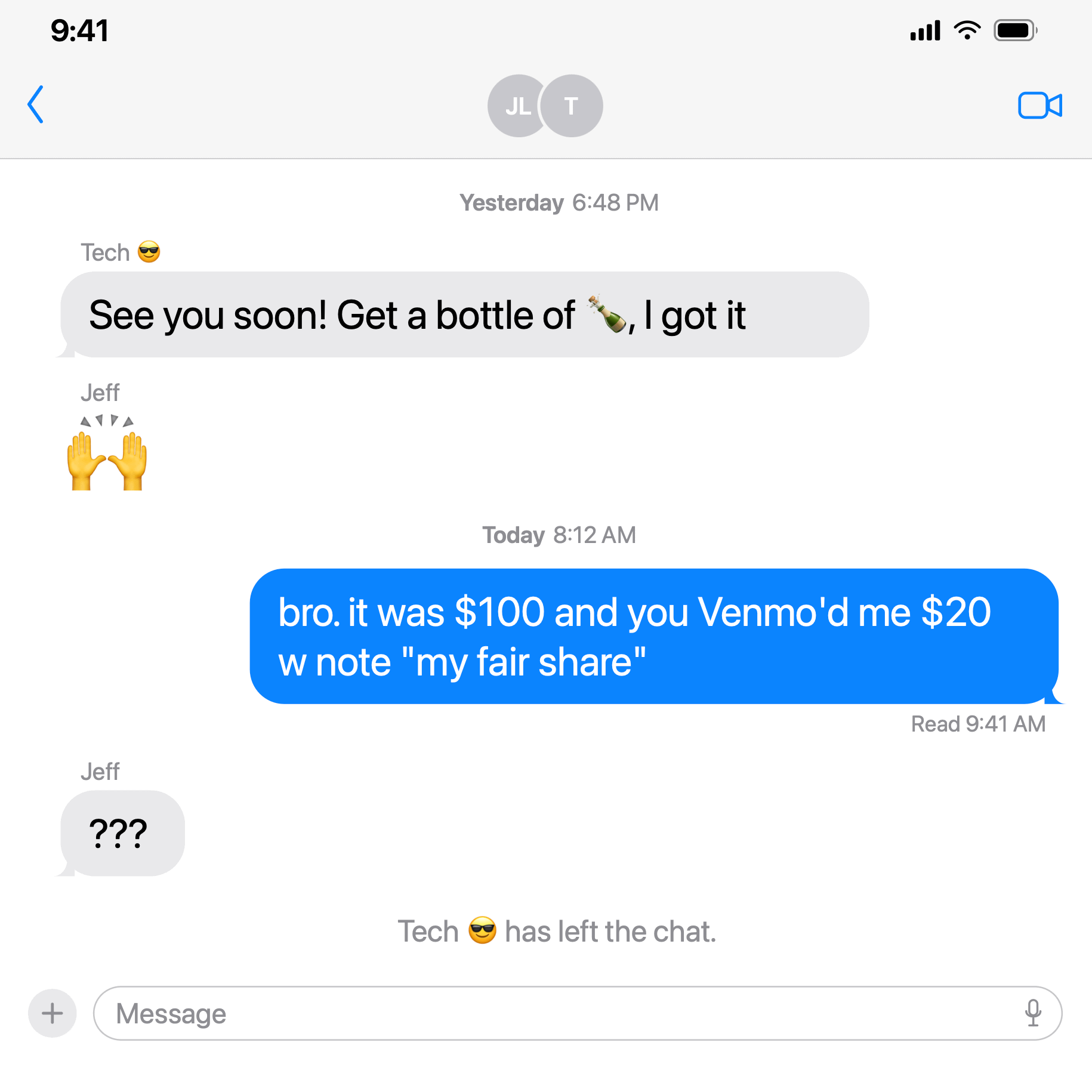
Imagine you and a friend are having beers at the local bar when a billionaire invites himself to join your table. He orders a bottle of champagne, because of course he does. After drinking a glass, he gets up and throws down a twenty. “That covers my portion!” he says on his way out, leaving you to pay for most of a bottle of champagne you never wanted. This is ridiculous—and it’s basically Meta’s power deal.
1. Entergy’s Fountain of Youth
Nobody is happier about this deal than Entergy.
On paper, Entergy looked its age when it gathered its investors at the Four Seasons in New Orleans in June 2024. Total electricity sales at its largest subsidiary, the century-old Entergy Louisiana, had grown less than 1% annually in the previous thirty years.3 The utility’s plans were similarly sleepy: the presentation that day pegged its three-year plan for new natural-gas generation at a modest $235 million.
But when Phillip May, Entergy Louisiana’s president, took the stage with his fellow panelist, Susan Bonnett Bourgeois, Louisiana’s economic-development secretary, they were like kids sitting on a secret they’d been told not to tell. They regaled the audience with the story of May’s meeting with Governor Landry about a potential sales tax exemption. They withheld May’s then-secret dinner with Meta shortly before the Landry meeting, where the topic was tax breaks, but there were details about how lobbying efforts had “hijacked” an unrelated state bill to secure those exemptions. The job description of a regulated utility usually doesn’t include lobbying for technology companies, but this stodgy old monopoly was determined to find its Corporate Botox.
Entergy celebrated its subsequent parabolic up-and-to-the-right move at this June’s investor meeting, now held at the New York Stock Exchange. Referring to Meta and Amazon, which both sent executives to join the utility on stage, May said, “One of the job hazards of working with folks like this is we have permanent smile on our face.” Botox will do that.
Entergy Louisiana’s three-year plan for natural-gas power plants had grown to $14.8 billion, sixty-three times what it showed investors two years earlier. Over the past thirty years, Entergy Louisiana has spent about $10 billion on power plants. Over the next five, it plans $32 billion.4
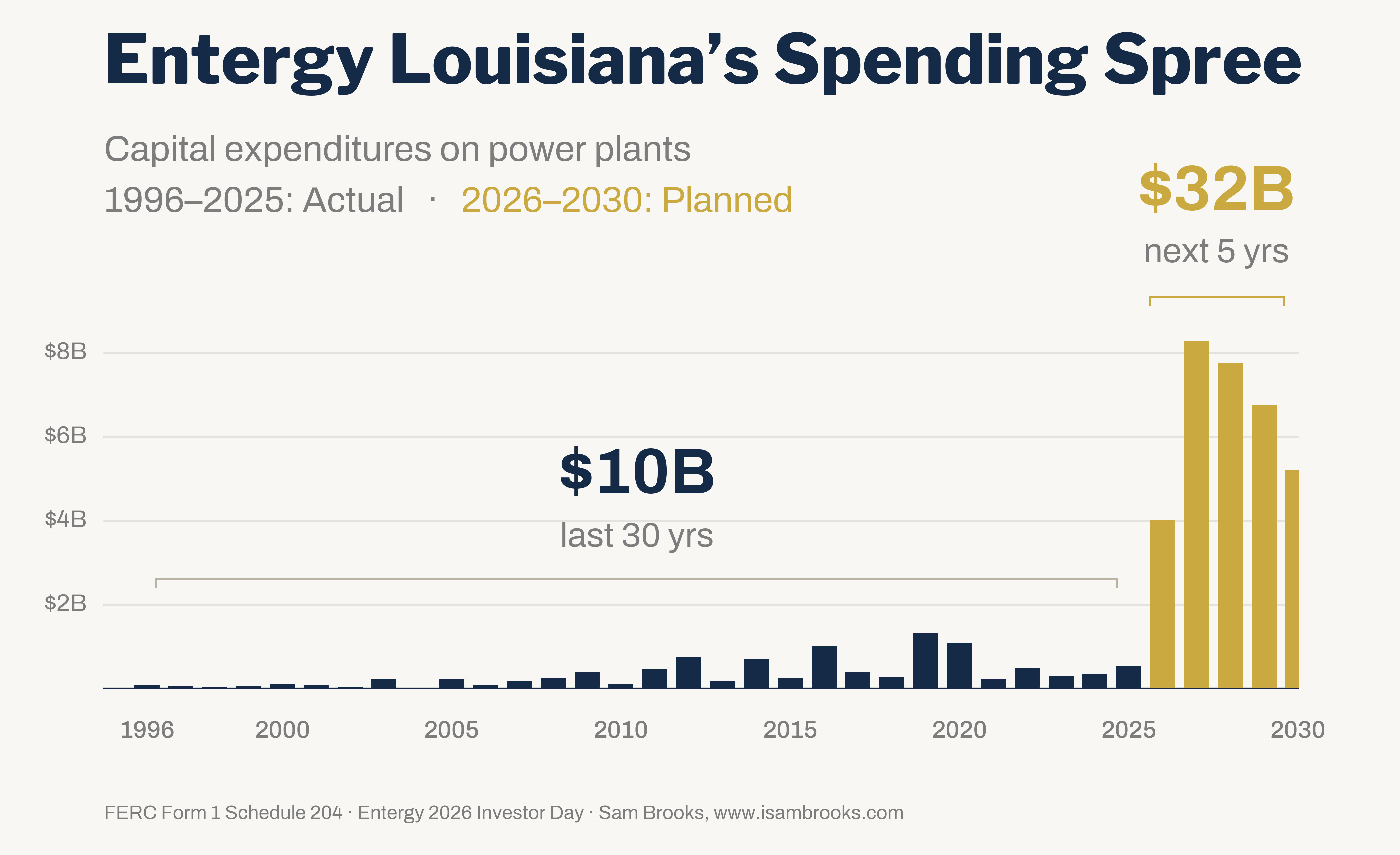
Entergy will reap unprecedented profits from this spending.
That isn’t a prediction. That’s how this system was designed. A century ago, when the government was willing to make extraordinary concessions to electrify the country, the basic bargain took hold: when a utility spends money on new assets that benefit its customers, it earns a guaranteed return on that money—paid each month, for decades, from those customers’ bills.56
2. The “Business” Model
The utility business model—a generous phrase, given these “businesses” have no competition and guaranteed profits—fits on a map of Richland Parish, Louisiana. Franklin Farms 1 and 2, the power plants now under construction, sit two miles up the road from Hyperion (or, in units Entergy executives would recognize, about the length of the runways at the nearby Monroe airport).
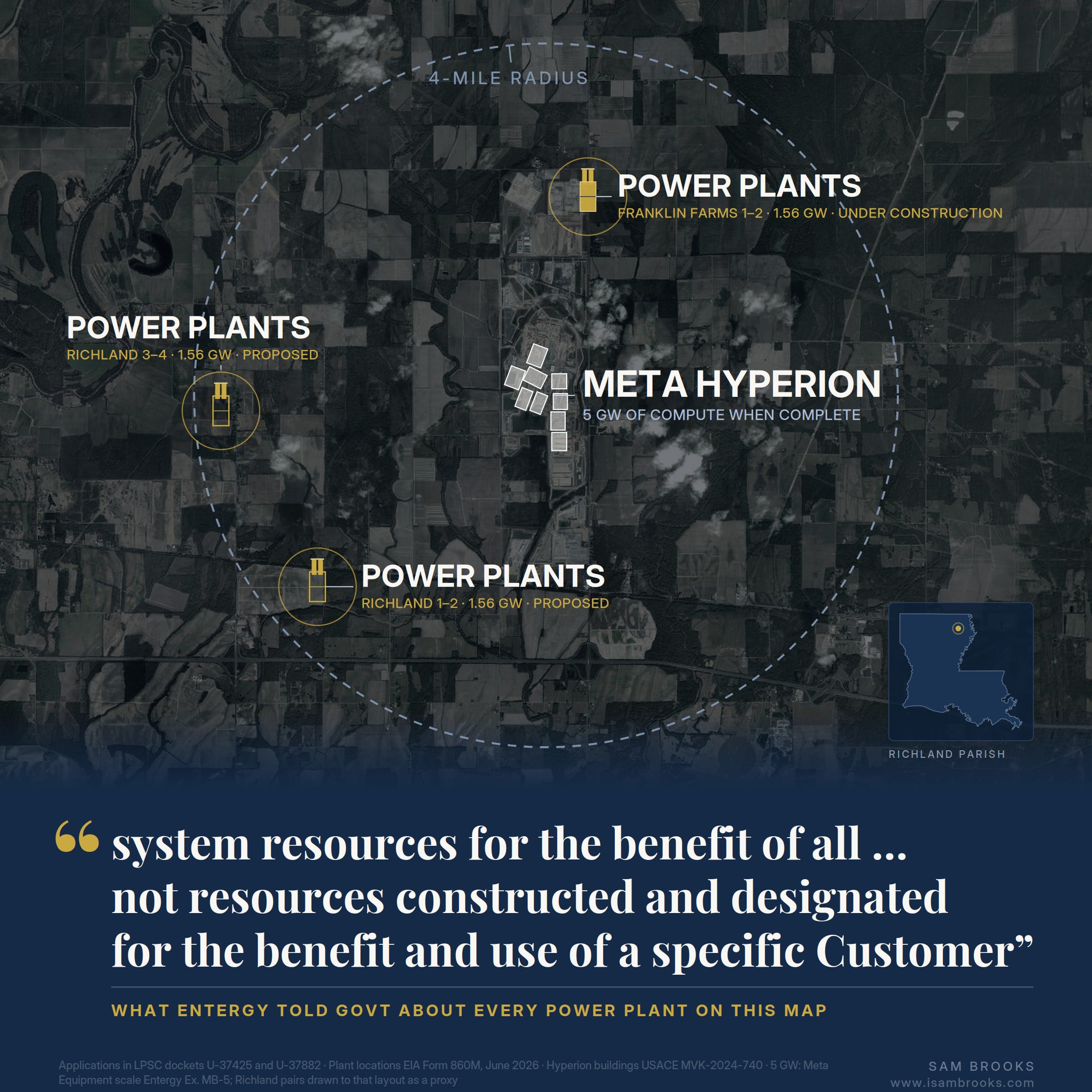
Everything about this says Meta. These power plants exist because Meta asked for them. They’re planted around the campus’ fence line and sized to the megawatt for Meta’s planned servers. In the office of Entergy Louisiana’s Phillip May, a white shovel with a big Meta logo leans against the wall. These power plants are, by any normal definition, Meta’s power plants.

Entergy’s CEO, Drew Marsh, says so himself. On an investor conference call last fall, he was asked about “the potential for data centers to build on-site power generation themselves.” Marsh said Entergy already builds plants “very close to where the customer is located … you can see that with the Meta project.” Call them Entergy’s or call them Meta’s; it’s all the same. Marsh continued: “from a physical grid perspective … there’s a distinction without a difference.”
But from the money-flow perspective, there’s a distinct difference. And it’s a difference Entergy remembers whenever government officials are around.7
When May and Marsh smiled for the cameras at the Franklin Farms groundbreaking last December, they were surrounded by local government officials and a state regulator—but not a single Meta executive. The dignitaries held chrome shovels full of dirt; the white Meta one, apparently, didn’t make it onto Entergy’s PJ to Monroe that morning.8
In the utility’s press release for the event, the word “Meta” doesn’t appear until the seventh paragraph, and May’s description of the plants never mentions the company at all. The plants, he said, are “the next step in Entergy Louisiana’s long-term strategy” that will deliver “cost-effective power to our customers.” May thanked “our partners from local and state governments, the Franklin family and our communities.”
Who’s Meta? Never heard of him.
In Entergy’s official application—which spelled out how it would fund, build, and get paid back for the power plants—the utility went out of its way to say they are not Meta’s. It asked that the assets be approved “as system resources for the benefit of all ELL customers, and not as resources constructed and designated for the benefit and use of a specific Customer.” The settlement Entergy signed with the Louisiana Public Service Commission’s staff, Walmart, and the Sierra Club said it again.9
The Commission’s final order, now the law of the land, said simply (in utility-speak, “Planned Generators” are the power plants; “ELL” is Entergy Louisiana):

3. “Fair Share”
This deal has clear winners:
Meta doesn’t want to pay the full costs for these power plants if it doesn’t have to. Good news for Meta: it doesn’t have to.
Entergy wins twice over, in fact:
Up and to the right: its capital spending plan, its stock, its forecasted profits—all moving in the right direction.
1.1 million ways to win: Wall Street wouldn’t have doubled Entergy’s stock if this investment depended on one customer. It doesn’t. These power plants are all “system resources,” so all 1.1 million homes and businesses are on the hook to pay Entergy back.
If you believe Entergy, though, there’s a third winner: every Louisianan with a power bill. (Don’t believe Entergy.)
It’s as ridiculous as it sounds. Entergy’s repayment is guaranteed—that’s the whole system—so, as with everything in life, there are tradeoffs here. Every dollar Meta comes up short of “full” for its power plants is, by design, a dollar paid by everyone else.
Still, Entergy relentlessly sells its “Fair Share Plus” pledge. Announced in coordination with a White House event in March and later turned into state policy by Governor Landry, the pledge says: “Data centers that move to our region must … pay their fair share for the power they use, plus create additional savings or benefits.” Entergy says the pledge lives in Meta’s Electric Service Agreement (ESA)—the contract that spells out what Meta pays.
But the Commission never approved the ESA. On purpose, at Entergy’s urging.
The order that made everything official and legal says that nothing in the certification “should be construed as approval of the ESA … or any of the terms contained therein.” The very next provision declares the plants “system resources for all ELL customers.” A few pages later, the order says its silence on the agreement “shall in no way limit or undermine” Entergy’s ability to recover its costs and profit from the power plants.
Entergy and Meta will tell you none of this matters. They’ll say the agreement and pledge have minimum bills and guarantees. Right.
Coming Up
In future post(s), I’ll dive into this agreement’s minimums and guarantees, and how much Entergy will profit, and how much everyone on the grid will likely pay. The ESA itself isn’t public, and most of what the legal filings say about it is redacted, but I’ve got some clues.
On this page, expect more original research and stories about the most rigged businesses in America: hiding-in-plain-sight fraud in data center power deals; mountains (some might call a bubble) of debt; engineering (financial, not physical) that turns blackouts into profits. It never ends.
Other AI tools responded similarly. Claude: “Meta is footing the bill for the power plants directly.” Gemini: “Meta Platforms is contractually funding the construction and power infrastructure.” (August 2026)
The latest estimated cost for the first three power plants: $3,999 million (Entergy's Aug. 2026 quarterly report, Docket U-37425). To determine the revenue requirement, I used Entergy Louisiana's latest Test Year (2025) data: 50.83% equity / 49.17% debt, 9.70% ROE, 4.22% cost of debt, 25.345% income tax, 30-year straight-line depreciation. Result: $9.3 billion, plus a $491 million turbine-service agreement—$9.8 billion before costs including O&M and fuel. I have excluded O&M and fuel from this calculation because those costs assume the plants will be running.
U.S. Energy Information Administration, Form EIA-861, Annual Electric Power Industry Report, "Sales to Ultimate Customers.” Prior to 2015, I added the Louisiana sales of Entergy Gulf States Louisiana, the sister utility that merged into Entergy Louisiana in 2015.
It’s as if Entergy has adopted the planning habits of its new friends in big tech. In February 2025, the firm’s quarterly update showed a $2.3 billion plan for new natural-gas power plants for 2026-2027. In June 2026, Entergy told Wall Street it expected to spend $9.4 billion during that same two-year period. Sixteen months; quadrupled spending. This kind of rapid change is not normal in this industry—with its government regulation and oversight—because plans are supposed to pass through, you know, regulation and oversight.
Entergy expects to make so much money that it seems almost embarrassed to say how much.
“Greater than 8%” reads the title of slide seven in its July 29, 2026 update to Wall Street. The slide then details Entergy’s forecasted earnings for each of the next five years, from $3.91 a share last year to $7.20 in 2030. (7.20 ÷ 3.91)^(1/5) – 1 = 12.99% In other words, Entergy actually expects annual growth of 12.99%—a whole lot greater than 8%.
On Wall Street, 499 basis points is a lot when it comes to earnings growth and not something a company would ever leave to careless editing. Haters might suggest that Entergy, wary of data center backlash, did not want to show the public how much money it’s making from data centers. (I would say that, too.)
In the first several decades of the twentieth century, a compact took hold (and was subsequently affirmed by the Supreme Court). In exchange for “regulation,” the government—which wanted to electrify the country as fast as possible—assured utilities that any prudent investment would be repaid, plus a “reasonable” return for their lenders and investors. I assure you, dear reader, that I will write no more than 50,000 words in future articles that describe and criticize this antiquated arrangement.
In legal documents, Entergy acknowledges the money-flow perspective. Next to Franklin Farms, several substations are being built to link the power plants with the Hyperion building. These substations are being funded directly by Meta: the technology firm is putting up the cash to pay for these assets, no 30-year payback-to-the-utility involved. In its formal application, the same one in which the power plants are called “system resources,” Entergy calls these “Customer-Paid Substations.”
Entergy’s leased Bombardier jets have made at least sixteen trips to the Monroe airport since January 1, 2024, including a flight in from New Orleans on the morning of the Franklin Farms groundbreaking (December 1, 2025).
I went on a week-long PJ kick—researching, not flying; I wish—for my book. I have so much in my notes about the utility industry’s use of private jets that I could probably write a whole other book on the topic. My research about Entergy’s fleet includes transponder data, job postings for pilots, radio registrations, and more. I don’t plan to release any of that here, even in the footnotes, because I’m aware that publicly available aircraft information has been used to threaten the safety of the people it’s released about. I’ll probably surface other items from time to time: the run to Las Vegas for the Super Bowl is probably too good to leave out; and don’t worry Duke Energy, looking at you too! But I’ll be careful about sourcing. If journalists or anyone else wants to check my work: contact me.
On July 3, 2025, the Sierra Club filed a brief with the Louisiana Public Service Commission that began “The Commission should reject the Application of Entergy Louisiana … to build over 2 GW of generation … to serve a large data center customer (’Meta’),” and called the proposal “not in the public interest.” It asked the Commission, specifically, to “reject the Company’s request to include and treat the proposed CCCTs as system resources for the benefit of all ELL customers.”
On July 11, the Sierra Club signed a settlement with Entergy, the Commission’s staff, and Walmart that says “The Planned Generators are to be treated as system resources for all [Entergy Louisiana] customers.”
Entergy had already proposed a new 1,500 MW subscription-based solar program in December 2024. The final settlement paperwork does include language that Entergy would make “commercially reasonable best efforts” to file for 500 MW within six months, but this does not line up with their pre-hearing demands. I do not know what other concessions may or may not have been made. What I do know: eight days after saying the opposite, the Sierra Club was fine with everyone on Entergy Louisiana’s grid paying for Meta’s gas-fired power plants. Cool, cool.
Going HAM in the footnotes.