

The CEO of Exelon, the utility that delivers power in Chicago, Philly, Baltimore, and DC, is sounding the alarm: electricity consumption is skyrocketing — at a pace unseen in “decades,” “30 to 40 years,” or maybe ever — and the grid isn’t keeping up. Calvin Butler delivers this message in interview after interview, often in an almost somber tone, at the pace of someone choosing his words carefully.
“The unprecedented load growth that we’re experiencing,” as Butler explained recently on the sidelines of the UN General Assembly, has consequences. “Now you have a level of growth that we don’t have adequate supply to meet.”
In Butler’s telling, real danger lurks on an especially hot or cold day. “You might have a supply crunch,” he told Fortune’s Brainstorm AI conference, “and people are going to suffer.” As he put it to the Financial Times, Americans could “absolutely” see blackouts in 2027 if supply doesn’t catch up.
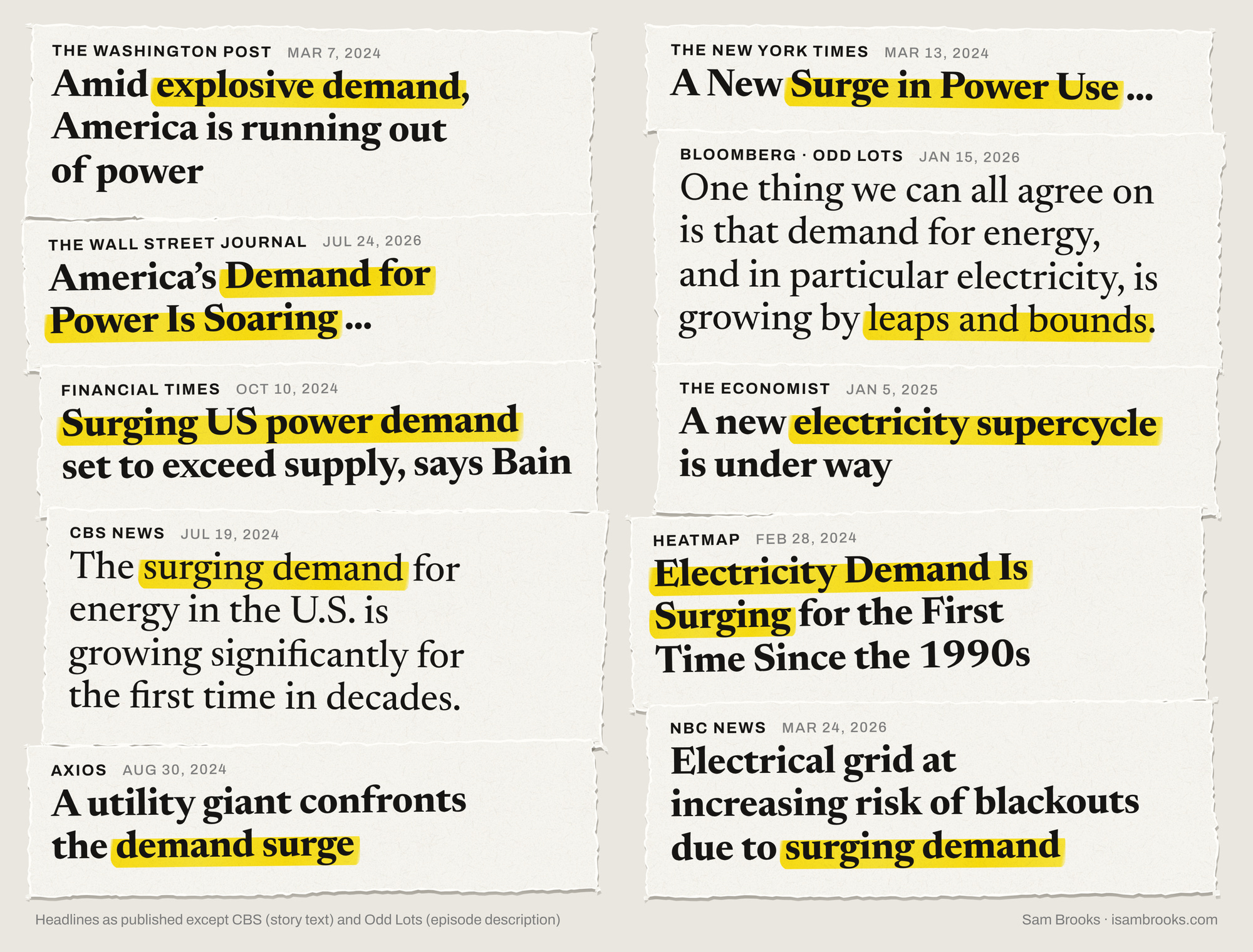
Butler’s warning is stark, but probably sounds familiar: a version of it runs in story after story about data centers. Over the past several years, the media has worked through the thesaurus to describe electricity demand: “surging” (CBS, NBC, New York Times, Reuters); “soaring” (Wall Street Journal, Fortune); “booming” (Bloomberg); “supercycle” (Economist); “explosive” (Washington Post).
Sometimes the utility skips the middleman. In May, Exelon’s Philly utility, PECO, ran sponsored content in the Philadelphia Inquirer about the “rising costs of keeping the lights on.” PECO was unequivocal about the cause: “After about two decades of flat growth in electricity usage, consumption soared nationwide in 2023.”
Like so much from Exelon and its CEO, that’s simply not true.1
Power demand isn’t surging
Nationwide, electricity use grew 1.2% over the past year (and was down in 2023). Far from “increasing faster than at any point in the past century,” as Exelon’s website says, demand grew faster in 75 of the last 100 years.2
For Exelon specifically, in the year ending June 2026, its customers used 196 terawatt-hours (TWh) of electricity. That was all the way up from 195 TWh in the previous year. In 2016, it was 203 TWh; in 2000, it was 197 TWh.3
Exelon is no different from most 21st-century utilities: they’re boring, mature companies. Electricity sales are sluggish, and have been for a generation, because modern buildings and technologies have found ways to use electricity more efficiently.


Even in the relatively exciting commercial and industrial (C&I) sectors, the place where data centers show up, growth has actually slowed. Year-over-year C&I demand was up 3.2% in early 2025. In the most recent data, it’s up less than 2%. That’s slower than 18 out of the last 40 years.4
If you dig into the data, and slice it up just right, you can see data center flickers. A good example is Indiana. Over the past year, power consumption grew 3.6 TWh, the fifth-largest increase of any state,5 and I think I’ve figured out where most of it came from: Project Rainier, a data center in New Carlisle that Amazon calls “one of the world’s largest AI compute clusters.”6 That’s not nothing, but also, c’mon. Indiana’s statewide demand is up 3.5%, roughly the pace of inflation and nowhere near historic.
Unprecedented, on repeat
CNBC’s Brian Sullivan said to Butler last November, “you’ve been very, very vociferous about a coming likely shortage of power.” He has indeed. For the last two years — including a year as chair of the Edison Electric Institute, the utility industry’s trade group — Butler has said pretty much the same thing. Some typical lines:
“This is probably the most growth we’ve seen in our industry since the advent of air conditioning” - Axios, 8/30/24
“Increased demand like we’ve never seen in the last 30 to 40 years” - CNBC, 11/10/25
“Our growth is unprecedented in the last several decades” - Fox News, 2/2/26
“As demand growth accelerated” - Letter to Our Shareholders, 3/18/26 (Annual Shareholder Meeting, letter co-signed by Exelon Board Chair Paul Bowers)
“Increasing electricity demand, ballooning load growth” - Annual Shareholder Meeting, 4/28/26
Butler’s web of storytelling sometimes borders on parody. In a recent Fox News Op-Ed, he wrote, “Electricity demand is rising fast.” To support the claim, this line links to a story by Bret Baier. There, readers looking for evidence can find a leading utility executive describing electricity demand: “Our growth is unprecedented in the last several decades.” That executive was Exelon CEO Calvin Butler.
In fairness to Exelon’s CEO, I’ll point out two things:
It’s not just Butler. Many other industry execs push the same misleading idea, constantly describing power demand as soaring.7
Butler shifts, at times, between present and future tense. To CNBC’s Sullivan this summer, Butler referred to the need for electric supply “to fuel this future growth that we’re experiencing.” After telling the UN-week crowd that “we’re experiencing” unprecedented growth, he pivoted to Exelon’s forecast for the future.
If and when confronted with what’s on this page, I suspect Butler and Exelon may claim he was, in fact, talking about the future. For that defense to work, you have to ignore the words coming out of Butler’s mouth in the present.8
It’s worth pausing to underscore:
What Butler and other utility execs are doing is f’ing ridiculous.
No public company should be allowed to deceive people about its product’s sales, but electric utilities should face an especially high bar. They’ve been granted extraordinary rights — protected monopolies with virtually guaranteed profits — and, as stewards of the grid, they owe the public an honest accounting of the system they run.
Instead, by misrepresenting how much electricity is being consumed, utility executives are misleading people about their companies’ financial strength — and about the state of one of our most essential public goods: the power grid.
This isn’t OK, and it needs to stop.
But, sure, let’s talk about the future
Butler put numbers on a recent forecast:
“What’s different about this wave of growth right now is the speed at which it’s happening …. We have estimated by 2030 we will add another 30 gigawatts to ComEd’s system.”
ComEd, Exelon’s largest subsidiary, saw peak demand of 20.7 gigawatts (GW) in 2025, so adding 30 GW more would be a 145% increase. The Chicago utility’s biggest four-year gain in electricity sales since 2000: 9%.9
Butler’s expansive view of the future — where data centers’ power demand explodes — obviously has company. Sam Altman envisions a world where OpenAI runs a factory that “can produce a gigawatt of new AI infrastructure every week.” Nvidia's Jensen Huang imagines AI compute drawing “likely probably 1,000 times more than we currently have.” President Trump inhabits a planet where data centers soon need “more energy than the entire country produces right now … in fact, some people say almost double.”
The last time a technological advance sent grid demand soaring, it didn’t take a wild imagination to see what was happening.
Air conditioning was a rare luxury in 1955, something you enjoyed in a movie theater or a fancy train car, but in almost no homes. By 1975, a majority of American households had it. The power-hungry appliances fundamentally changed how and where people lived — in home after home, business after business — with electric demand tripling along the way.10
An AI-led power boom would unfold very differently.
Even if we assume the most bullish AI forecasts will materialize — and we should not — the added electricity would mostly show up in several hundred locations, usually far from population centers. This buildout would look nothing like the last one: most of these grid upgrades would be localized and remote. And whereas AC-era power plants and wires directly benefited tens of millions of customers, most of this wave would be built for maybe a dozen customers — a handful, really, of trillion-dollar tech companies.
It’s no surprise that Butler, Exelon, and the rest of the industry aren’t leaning into that story. “We’re building power plants and wires for data centers” sounds like a data center problem, and something data centers should pay for. But once the topic is the grid, writ large, that’s different.
Demand’s skyrocketing! We might not have enough supply!
Numbers are going up! Big time!
Blackouts! National security!
That water’s muddy, but it’s starting to feel like something we should all care about. And pay for.
A crisis with a budget
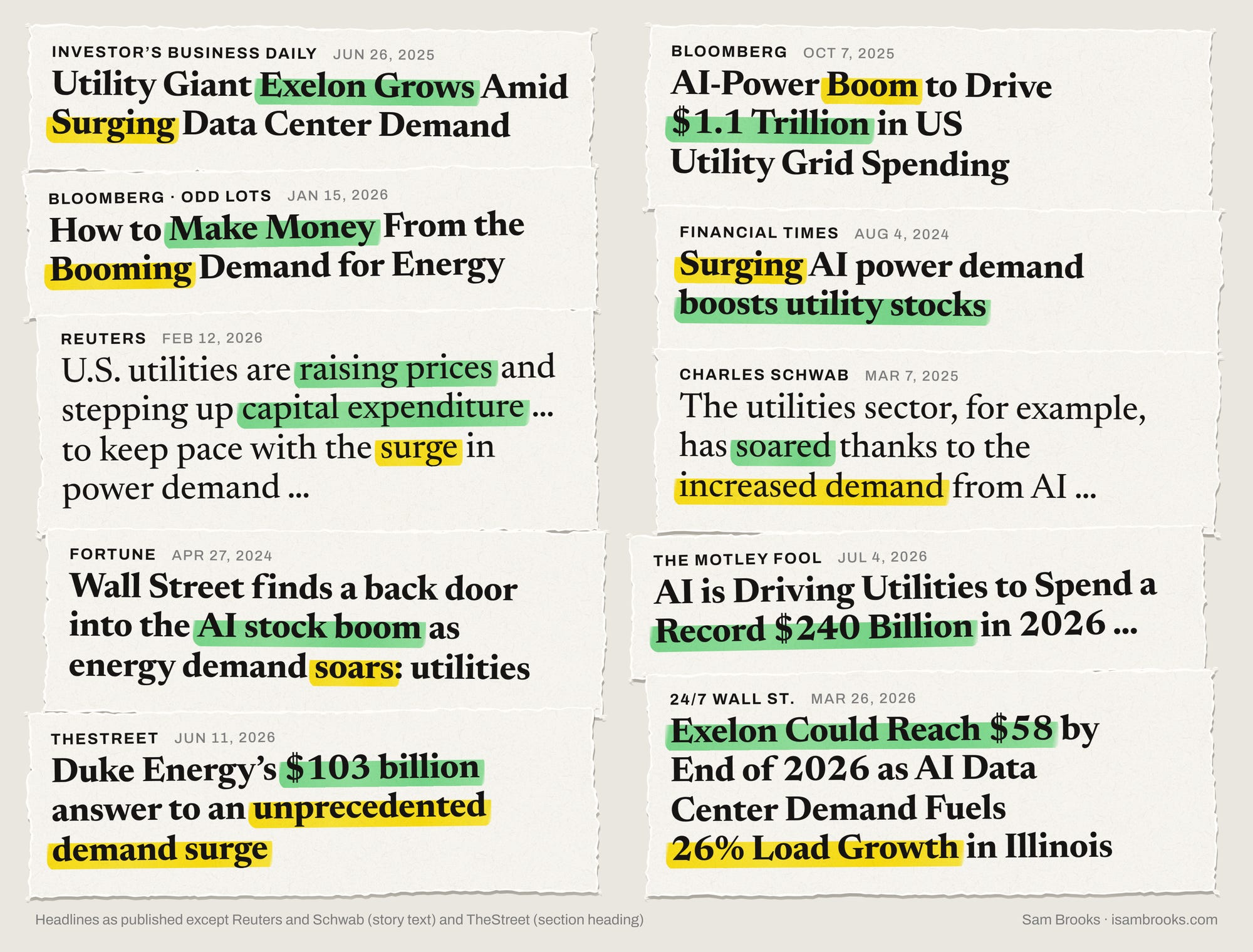
It’ll stun you to learn: Exelon has big plans to address this crisis.
At the event where Butler said ComEd’s demand would more than double, he pointed to Exelon’s plan to invest $41.7 billion of capital through 2029. Right after hitting his most-in-40-years note during a Fox Business appearance, he added, “we’re spending $10 billion in infrastructure this year to meet that demand.”
One of those infrastructure projects is in DeKalb County, Illinois, where ComEd recently won approval to build a new high-voltage transmission line. The new wire will start in the middle of a field, in a township of 901 people, and run six miles to a new substation on ComEd land. The property next door: a Meta data center.
An upcoming piece will dive into Exelon’s plans to support that growing community.
Later this week: More about how the dreams of utilities and big tech are stacking up against the reality of meter data.
Next week: The first of a series of deep investigations into the deals between utilities and data centers.
Georgia is home to some of the country’s most ambitious data center projects, including OpenAI’s, Microsoft’s, and Google’s. Georgia Power says data centers are paying the full cost of the infrastructure to power them and that, incredibly, “they will fund a discount of ~$180 per year to the typical residential customer.”
I’ll work through the details of Georgia Power’s data center power deals, which are typical of those across the industry. By the end of the piece, three possible outcomes will become clear:
Data center boom is real — and everyone’s power bills go down
Data center boom is not real — and everyone’s power bills go up
Data center boom is not real — and utilities face bankruptcy
Electricity sales actually fell 1.3% nationwide in 2023. PECO supplied a link within its sponsored content, but it goes to an EIA article about 2024 and forecasts for 2025 and 2026.
U.S. data from 1949 onward comes from the U.S. Energy Information Administration (EIA): most from Monthly Energy Review, Table 7.6, while recent year-over-year comparisons come from Form EIA-861M. “The past year” is August 2025 through July 2026, compared to August 2024 through July 2025. Pre-1949 data: Census Bureau’s Historical Statistics of the United States (1949 edition, series G 226; Millennial Edition, series Db232) and the 1949 Statistical Abstract. Leap years are adjusted to 365 days.
NOTE: if you want to browse the data yourself, EIA’s Electricity Data Browser is user friendly-ish. I’ve tried to create a helpful link here, but the browser can be a little squirrelly. What I suggest: find the “View a pre-generated report” box, then select “5.4 Retail sales of electricity to ultimate customers by end-use sector, by state.”
If you’re skeptical of what I’ve said here — and you’re certain data centers are changing everything, and you want to cherry-pick to find explosive demand — I’d suggest hunting in the commercial sectors, where EIA instructs utilities to report data centers (though beware it appears (or at least I suspect, strongly) that some utilities nevertheless continue to report data centers as industrial).
Exelon figures are for its six current utilities — ComEd, PECO, BGE, Pepco, Delmarva Power and Atlantic City Electric — in every year, including years before they joined Exelon. Data from 2018 onward: quarterly earnings releases via SEC filings; 2000-2017: Form EIA-861. (Note that in 2018, the year the data sets are joined, they differ by 0.01%.) FERC Form 1 filings were also used to cross-check the data. Leap years adjusted to 365 days.
See note 2.
Indiana added 3,614 GWh — statewide across all utilities and sectors — Aug 2025 to Jul 2026 (vs. Aug 2024 to Jul 2025). This ranks behind Ohio (+8,366), Arizona (+5,618), Virginia (+4,979), Texas (+4,341), and well ahead of states at the other end of the spectrum, where electricity consumption shrank, such as California (-3,431), Washington (-813), Illinois (-631), and Pennsylvania (-369). For context: I’d expect an AI data center with 1 GW of IT to add roughly 7,400 GWh annually.
I’ll further examine these figures (and many others) in a piece here in several days.
Amazon’s “Project Rainier” is a partnership with Anthropic in New Carlisle, Indiana. Using satellite imagery, Epoch AI estimates the campus came online in Jun 2025 with 398 MW of IT power (about 300,000 “H100-equivalents,” Epoch’s measure of computing power, pegged to Nvidia’s H100 chip; the campus itself runs Amazon’s Trainium2 chips); ramped up to 626 MW in Dec 2025 (471k H100-equivalents); 910 MW in Mar 2026 (686k); and 1,037 MW (818k) expected in Oct 2026. Using engineering approximations (1.2 for Power Usage Effectiveness (PUE), which measures total facility load versus the IT load itself; and 70% load factor, which measures a facility’s average power use versus peak power use), I estimated likely gigawatt-hours (GWh) of electricity consumption for Project Rainier and compared them with meter data from Indiana Michigan Power (I&M), the utility that serves New Carlisle:
569 GWh: my estimate for Project Rainier’s Jul 2026 power use, using Epoch’s estimated IT power (910 MW)
454 GWh: actual added Jul 2026 I&M commercial sector power use (vs. Jul 2024, the last July before Rainier came online)
4,694 GWh: my modeled estimate for Project Rainier’s power use, Aug 2025 to Jul 2026, using Epoch’s timeline for each expansion
3,377 GWh: actual added I&M commercial sector power use, Aug 2025 to Jul 2026, across all commercial customers (vs. Jun 2024 to May 2025, the 12 months before Project Rainier came online)
Butler’s misleading claims — while especially notable, given his chairmanship of the industry’s trade group (Edison Electric Institute) from June 2025 to June 2026 — are echoed by executives across the industry. These are not slips of the tongue; they do this constantly; this footnote could be many times longer.
AEP CEO Bill Fehrman: “a pace I have not seen in my 45-year energy career” (earnings conference call, 7/30/25)
Dominion CEO Robert Blue: “We’re witnessing the fastest growth in our Virginia service territory since the days after World War II” (S&P Global, 12/2/25); “unprecedented load growth … accelerating in orders of magnitude” (earnings conference call, 2/12/25)
Duke CEO Harry Sideris: “We’ve never seen load growth like we’ve experienced the last year” (Bloomberg, 6/3/26); “The growth is not theoretical. It is already showing up on our energy system” (Atlantic Council, 5/11/26)
Edison International (Southern California Edison parent) CEO Pedro Pizarro: “electricity demand growth unlike anything our industry has seen in decades” (Pizarro’s LinkedIn, 4/22/26)
Edison Electric Institute (EEI - utility industry association) CEO Drew Maloney: “unprecedented growth in the energy sector” (Electric Perspectives, 9/22/25)
EEI past-CEO Pat Vincent-Collawn: “Today, electricity demand is growing at its fastest pace in decades” (Electric Perspectives, 2/21/25)
EEI past-CEO and former DOE Secretary Dan Brouillette: “Electricity demand is growing exponentially all throughout the country” (Tulane business forum, 9/27/24)
Entergy CEO Drew Marsh: “The demand growth that’s taking place across the country and in Entergy’s service area is unlike anything we have seen in recent history—and, in some ways, ever” (Electric Perspectives, 5/26/25)
Georgia Power CEO Kim Greene: “an electricity demand surge unlike anything in recent memory” (Atlanta Journal-Constitution op-ed, 7/31/26)
NRECA CEO Jim Matheson: “Across the country, we know electric demand is surging … electric demand growth is the highest it has been in over two decades” (Congressional testimony, 4/30/25); “demand for electricity continues to soar” (NRECA press release, 11/8/23)
NextEra CEO John Ketchum: “unlike anything we’ve ever seen since the end of World War II” (earnings conference call, 4/23/25) and “unlike anything we’ve seen in generations” (NextEra–Dominion merger conference call, 5/18/26)
PG&E website: “the largest era of electric demand growth in United States history” (PG&E Currents, 6/18/25)
Portland General’s Maria Pope: “growing at a rate we haven’t seen in decades” (EEI’s Electric Perspectives, 3/17/25)
Xcel CEO Bob Frenzel: “an unprecedented surge in energy demand” (Frenzel’s LinkedIn, 9/30/25)
It’s not as if Calvin Butler is free-styling these comments. Other Exelon executives, and the company in its general public communications, convey similar comments about current power demand. For example:
Exelon’s EVP and Chief Legal Officer, Colette Honorable: “The load growth we face is unprecedented” and “What has dramatically changed is the demand on the electricity grid.” (Exelon - ‘The Grid’, 9/16/25)
ComEd statement: “The Illinois 2025 Resource Adequacy Study confirms what we have been seeing at ComEd: unprecedented growth in the demand for electric power.” (CBS, 12/17/25)
Exelon website: “Skyrocketing Demand” (Exelon website, accessed 10/5/26)
See note 3 regarding data sourcing.
A general comment about Butler’s forecast: there’s no chance — zero, none — that ComEd adds 30 GW, more than doubling demand, by 2030. In order for that to happen, AI product demand would need an extraordinarily bullish trajectory, probably beyond even the wildest dreams of Altman and Amodei, and Northern Illinois would need to become a hotbed of data center development, which would be shocking given the state’s political environment (Illinois Governor JB Pritzker recently halted tax incentives for new data centers). But even if both of those things happened, the data centers would need to be built at a physically impossible pace to meet Butler’s four-year window.
I’ve considered whether Butler misspoke about the 30 GW. Perhaps he did. But I’ve watched this section of the interview at least a dozen times and his answer seems prepared. My guess: he’s referring in round numbers to every single data center in ComEd’s pipeline, and then assuming they all show up by 2030. That’s … not going to happen, and it’s at odds with how the utility describes its expectations elsewhere, but the numbers roughly match up: in March, Illinois regulators put ComEd’s total pile of requests at 28 GW.
To my fellow energy nerds: yes, my 9% figure refers to annual energy consumption (GWh) and Butler’s 30 GW forecast refers to instantaneous power. But the energy yardstick provides useful perspective and, on a relative basis, it actually understates what Butler’s (very) theoretical load would do to sales. If 30 GW of data center power showed up on ComEd’s grid, that’d cause more than a 145% increase in GWh, given data center load factors versus grid-wide load factors.
See note 2.