If only we had more electricity!
The AI crowd always comes back to the same story: demand is huge — it’s basically infinite — but there’s not enough electricity to power the chips. As Microsoft CEO Satya Nadella explained last October:
“The biggest issue we are now having is not a compute glut, but it’s power … In fact, that is my problem today. It’s not a supply issue of chips; it’s actually the fact that I don’t have warm shells to plug into.”
We’re told that Microsoft, with all of its money and chips, is stuck waiting for electricity. CFO Amy Hood said last fall they’d “spent the past few years … short the space or the power” to run AI chips, and this April she said Microsoft expected “to remain constrained at least through 2026.” To Nadella, Hood, and every other concerned AI booster, allow me to share the good news:
Tons of power is available in Georgia — and has been for years.
Georgia Power recently listed ten data centers with signed contracts and gigawatts of available electric service (I’ve identified at least half as Microsoft’s).1
Now the bad news: the data centers are barely using it.
There are only two ways to explain this. Both are bad for Microsoft and for Georgia Power:
Many AI chips are still in warehouses, not data centers. That’s what Ed Zitron’s been arguing, and what Business Insider just reported at Amazon.
AI chips are installed at the data centers — but underused. That’s what I found at Colossus 2, which you can read about here.
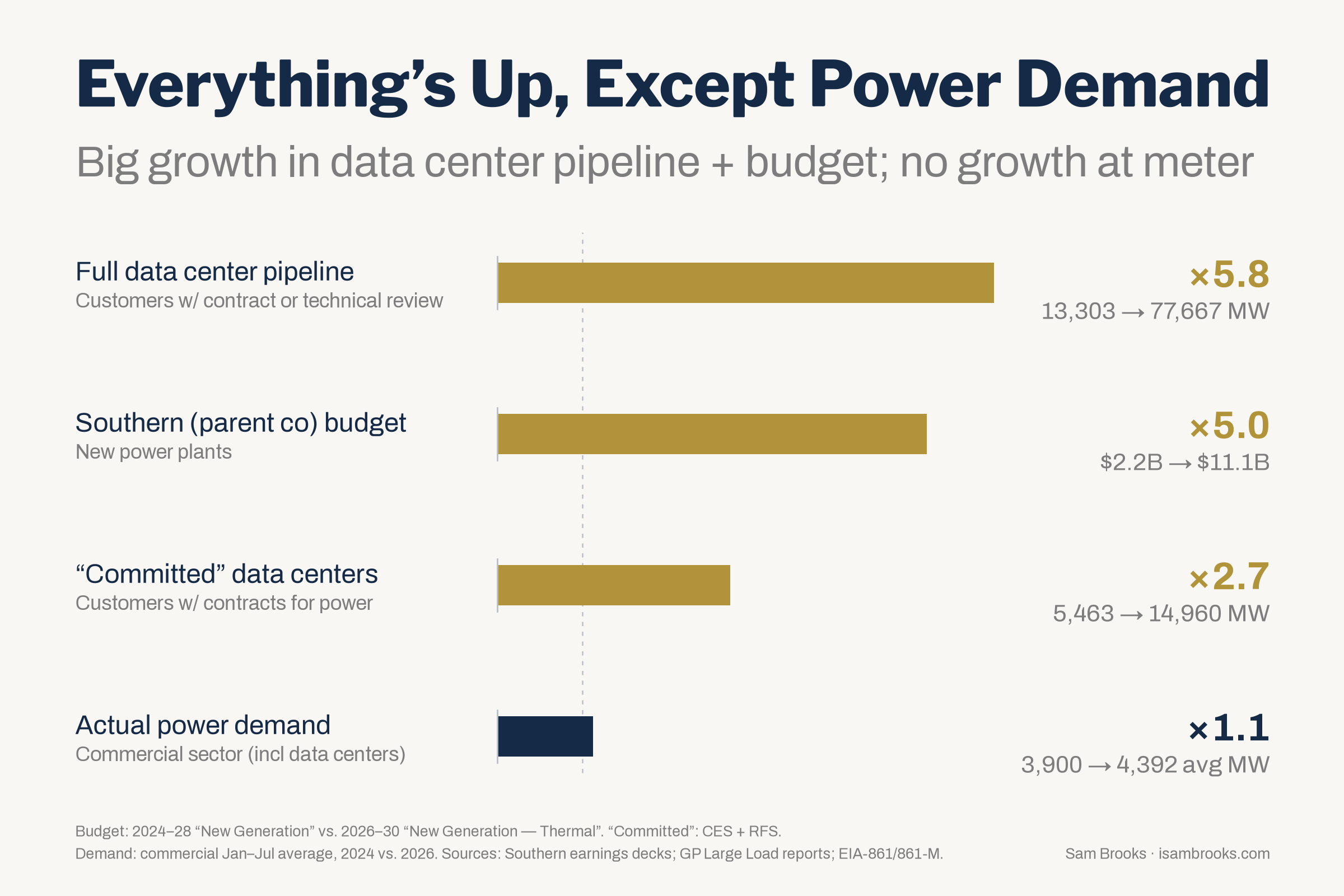
Either way, hyperscalers are spending billions of dollars on computer chips they’re not using — and electric utilities are spending billions of dollars on power plants that won’t be used.
How It Started
In a January 2022 employee newsletter, Georgia Power celebrated three Microsoft data center “wins,” resulting from a “system-wide innovative and collaborative effort” that’d been six years in the making. The utility was building infrastructure to deliver 590 MW to the three sites, and expected “to energize the substations for these centers during Q2 2023.”
By 2024, Georgia Power was talking in entire power plants. After state regulators approved 1,400 MW of new gas turbines that spring, Chris Womack, CEO of Southern Company (Georgia Power’s parent), told investors: “This approval affirms the need to quickly procure and deploy several thousand megawatts of resources to serve customers’ rapidly growing projected electricity demands.”
The utility next sought to keep a fleet of old power plants, over 4,000 MW of them, running into the 2030s. Regulators said yes in July 2025, then said yes again five months later to 9,885 MW of new power capacity. Georgia Power had been green-lit for enough plants to power Portugal.
By this January, Womack was making the rounds in Davos. He spoke to a Boston Consulting Group gathering where one of the firm’s partners reported “significant optimism in the room” about “partnerships between hyperscalers and utilities.” While in the Alps, Womack summed things up for Bloomberg:
“We’re seeing incredible growth, incredible demand, incredible opportunity to serve these data center customers, which is an incredible opportunity that we’re really excited about.”
It doesn’t take a $1,271-an-hour consultant to figure out what’s so exciting: if data centers say they’ll use lots of electricity, the utility can make lots of money by building lots of power plants.
Georgia Power tallies the AI boom’s demand — to justify building all the new supply — and publishes the figures in public (ish) regulatory documents.
In quarterly “Large Load” reports first filed in May 2024, the utility redacts individual customer names,2 but all the details are there. In row after row: project size, contract status, when service can begin, and scheduled MW by year. That first report listed 64 anonymous projects — 37 of them data centers, by my count — with the data centers scheduled to draw 1,438 MW in 2025 and 3,854 MW in 2026. The list has ballooned since.
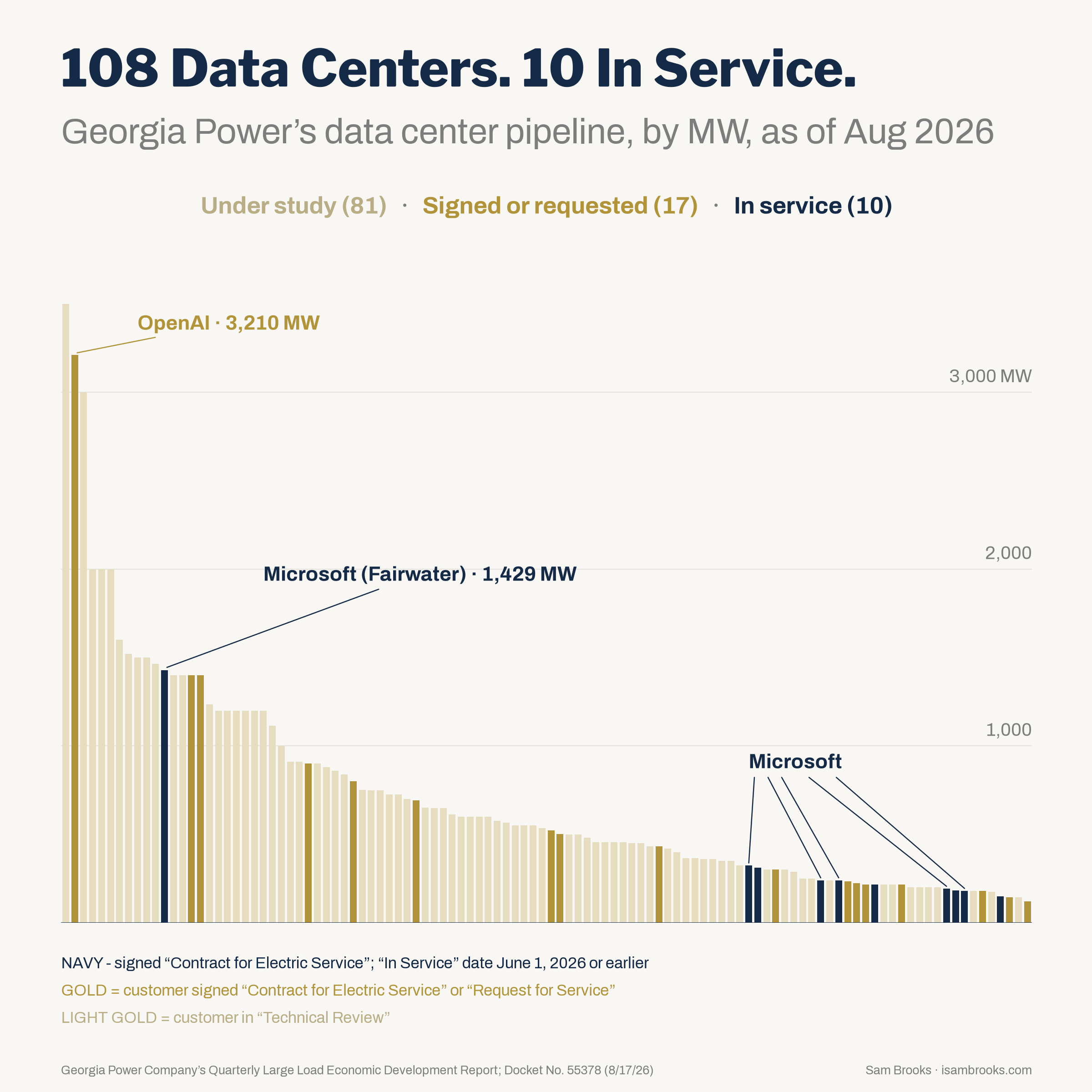
The August 2026 report lists 108 data centers: 19 with a signed “Contract for Electric Service” (9,149 MW total demand), 8 with a signed “Request for Service” (5,811 MW), and 81 in “Technical Review” (62,707 MW).3
About all this data …
There’s a reason this analysis doesn’t exist anywhere else. Two, actually:
The data. Footnote 2 details how I assembled this data — project sizes, phasing, contract status — from the eleven Large Load reports. I’ll simply note here that a conspiracy theorist might conclude Georgia Power releases the data in disorganized PDFs and Excel files for a reason: to make it nearly impossible to track. (That’s what I’ve concluded.)
The customers. I've cross-referenced that database against hundreds of publicly available documents to identify many of the rows’ customers and data centers.
Sometimes it’s easy. Exhibit A: OpenAI’s Project Camellia, announced in July as “contracting with Georgia Power Company for 3.2 gigawatts of power … in phases between 2028 and 2032.” In Georgia Power’s August report, one customer, name redacted, is listed with a “Request for Service” for 3,210 MW (i.e., 3.2 gigawatts) phased in between 2028 and 2032.
Microsoft’s data centers required more digging (see Footnote 1 for a thousand words on how I pinpointed things), but the short version is that I triangulated Georgia Power's paperwork against itself: the eleven Large Load reports, grid plans and equipment filings and press releases, and one very proud employee newsletter.
Given that a critic of Georgia Power spent nearly two days in a Fulton County jail for picking up the wrong binder at a hearing (she was suspected of a "trade secrets" felony), let me be clear: everything in this article has come from public documents.
How It’s Going
By all accounts, Georgia was supposed to be humming with data center demand by 2026.
Georgia Power’s power-plant plan said so (Oct 2023): “to address this extraordinary load growth, the Company must procure resources to support capacity needs beginning in the winter of 2025/2026”
Southern’s CFO said so (Feb 2024): “the significant load really begins to come in, say, late 2025 and into 2026”
State regulators said so (April 2024): “urgent capacity needs” — so urgent they let Georgia Power skip competitive bidding for new turbines
CEO Womack said so (May 2024): “rapidly growing projected electricity demands by the winter of 2026”
Georgia Power’s Q3 2024 data center report said so (Nov 2024): “large load customers are materializing and making progress without material delays”
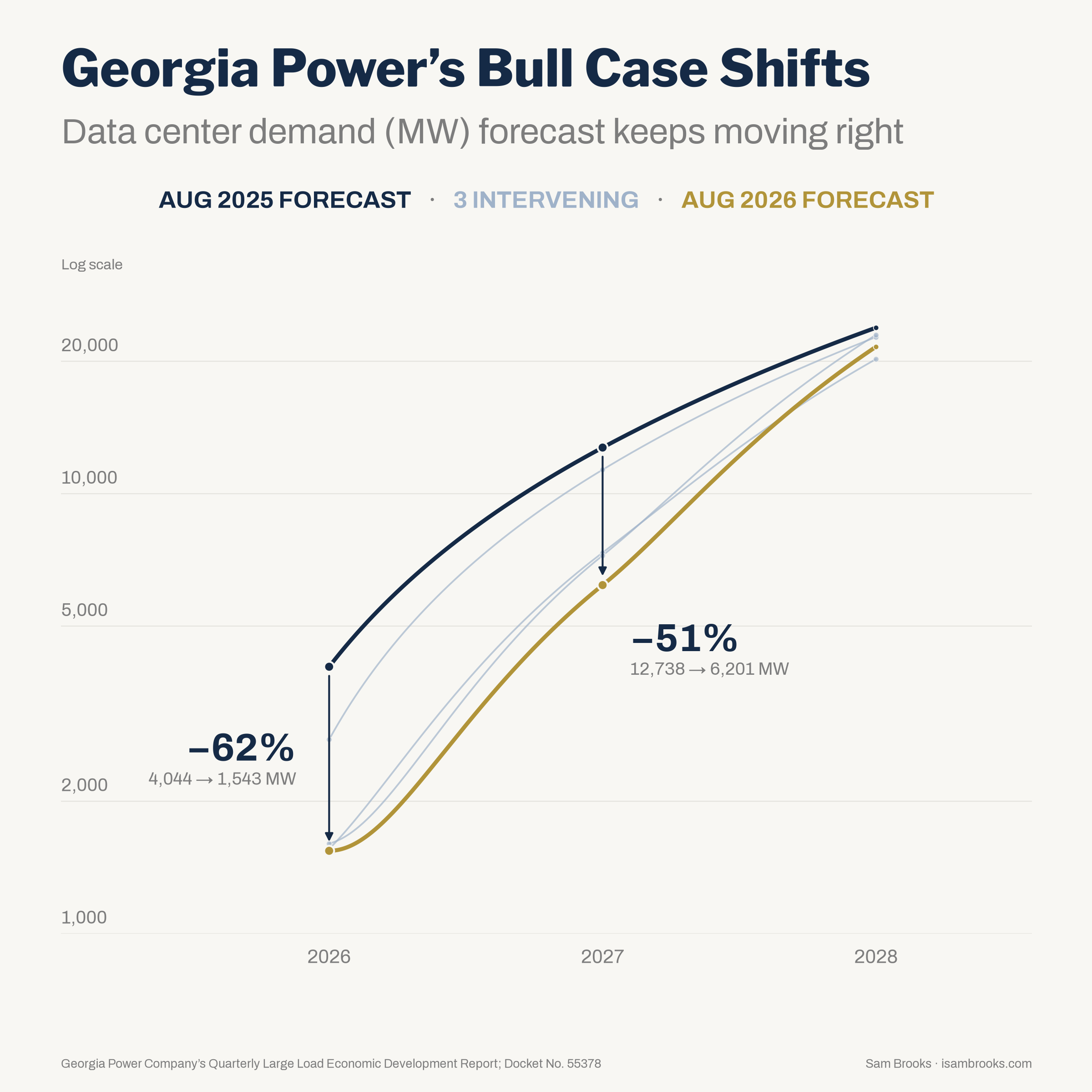
Georgia Power’s Q1 2025 data center report said so (May 2025): 4,445 MW scheduled for 2026
After all that — the urgency to procure new power plants, and the certainty of the demand to use them — the meter should be spinning hard by now.4
But it’s barely spinning at all.
In monthly filings with the federal government, Georgia Power reports how much power it sells, including to its “commercial” customers, a group that includes its data centers. Through July of this year, the entire group — every office, store, and hospital it serves, plus the data centers — is using an average of 332 MW more power than the same months in 2025. Across the last two years, the entire commercial sector is up just 492 MW.
492 MW.
Even if we make the (bad) assumption that all 492 MW are data centers, that’s a big gap from the 4,445 MW of data center power Georgia Power expected in 2026, in its forecast filed just last year.5
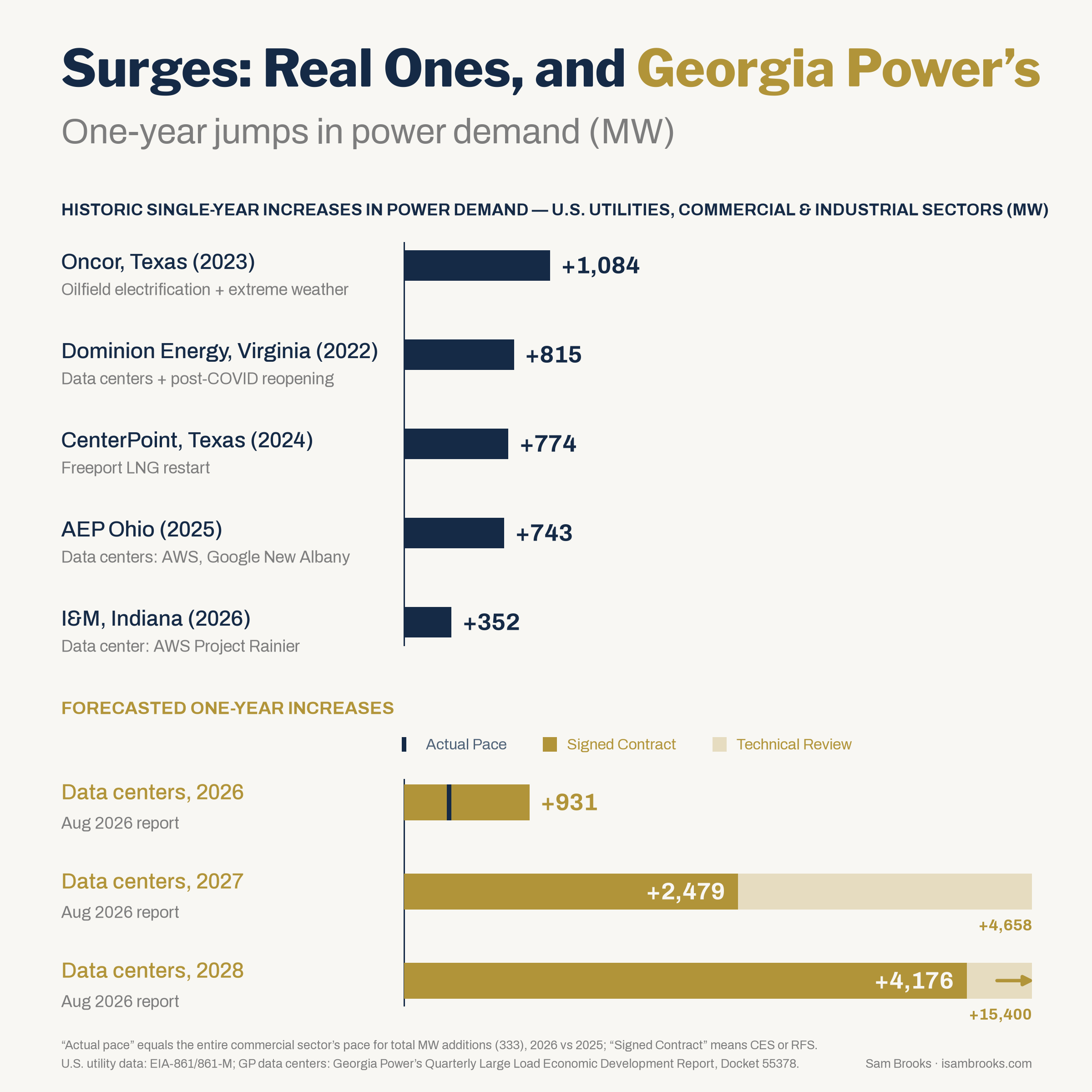
That’s a lot of numbers. Shout out to the Rain Men breezing along, but in plain English:
Georgia Power is ready to supply a ton of power — but the data centers aren’t using it.
Warm Shells
It’s not like Microsoft disputes the power is on. Last December, Microsoft boasted: “Our datacenter footprint in Greater Atlanta Metro area is already running the most advanced AI supercomputers on the planet.” In a January 2024 filing, the firm described itself as “a large consumer of Georgia Power with particularized needs for electric service.”
Georgia Power’s been meeting these particular data center needs for years. I’ve pinned down six Microsoft data centers on the utility’s Large Load reports:
Fairwater, which Microsoft calls “the world’s first planet-scale AI superfactory,” contracted for 1,429 MW
Microsoft’s campus in Union City, built by EdgeConneX (324 MW)
Shugart (240 MW), Riverside West (192 MW), East Point (180 MW), plus another 240 MW project
All six of these data centers have signed “Contracts for Electric Service.” All six have an “Initial In Service Date” that’s already arrived; Fairwater’s service date was two and a half years ago, on April 26, 2024. But despite all of this — the contracts, and the substations, and the power plants — there’s one unavoidable fact:
The data centers aren’t actually using much power.
I know that because Georgia Power’s entire commercial sector, which includes every other data center on its system, is on pace to add just 332 MW this year. Two months ago, Georgia Power still expected Microsoft alone to use 1,157 MW this year.
Satya should feel free to plug in. The shells are warm — and unused.
If you like this post (tbh even if you don’t), I’d be eternally grateful if you’d share it far and wide!
“I’ve identified at least half as Microsoft’s”
Though the customer names on Georgia Power’s Large Load reports are redacted, I have developed considerable circumstantial evidence — by cross-referencing the utility’s reports against each other, and other publicly available documents — to say with very high confidence that five of the ten data centers with signed contracts and live service dates are Microsoft’s, and a sixth almost certainly is.
In Georgia Power’s Large Load reports, the first four columns — “Project Name,” “City,” “County,” and “GPS Coordinates” — are marked as REDACTED on every row. The remaining columns are public, and five hold keys to piecing things together:
“Announced Load”: the customer’s fully planned power demand (MW).
“Initial In Service Date”: the date on which a customer’s electricity can begin to flow.
Annual: the amount of demand Georgia Power assigns to the customer in each year, a figure that rises as a project phases in.
“Project Stage”: whether the customer is in Technical Review, has signed a Request for Service, or has signed a Contract for Electric Service. These listings sometimes carry footnotes, which sometimes specify that a customer’s site has contracted for only a portion of its total Announced Load.
“Territory”: whether the site is “Inside” or “Outside” Georgia Power’s territory. Georgia divides electric-service areas among different utilities, but qualifying large customers can choose their supplier. A data center can therefore sit outside Georgia Power’s territory and still buy its electricity from Georgia Power; such a data center would be listed as “Outside.”


FAIRWATER
Georgia Power’s 2023 transmission plan names QTS Fayetteville as the customer it was building a new substation for, outside its own territory; QTS told Georgia Power the campus would need 1.4 GW; Microsoft’s Fairwater is that QTS campus, and it’s running. In Georgia Power’s August 2026 report, there are only four data center rows with a signed Contract for Electric Service, with a present In Service date, and that are outside of Georgia Power’s territory. One has Announced Load of 1,429; the next highest is 240 MW (see: Palmetto, below). This 1,429 row is, without a doubt, Microsoft’s Fairwater campus.
SHUGART, RIVERSIDE WEST, SOUTHMEADOW
Georgia Power’s Jan 2022 Circuit newsletter names three Microsoft data centers by name and size (matched here to their cities): Shugart/Palmetto (240 MW), Riverside West/Douglasville (200 MW), and Southmeadow/East Point (150 MW). It explicitly places each outside the utility’s territory; Microsoft itself names Douglasville, Palmetto, and East Point in a January 2024 regulatory filing.
Shugart/Palmetto. By its February 2025 report, Georgia Power had exactly four Outside data centers with a signed Contract for Electric Service (CES): 1,429 (Fairwater), 240, 192 and 180. The 240 perfectly matches the 240 MW Shugart project named in the utility’s newsletter.
Riverside West/Douglasville. In the May 2024 report, one of only two Outside projects with a signed CES (the other was Fairwater, then listed at 1,492) had an Announced Load of 200 MW, perfectly matching the 200 MW Riverside West project identified in the utility’s newsletter. (Note that in the Nov 2024 report, this project’s Announced Load shifts from 200 MW to 192 MW.)
Southmeadow/East Point. This identification comes from several pieces of evidence that reinforce each other:
In Georgia Power’s May 2025 Large Load report, there are only four data centers outside of Georgia Power’s territory with a signed CES: 1,429 (Fairwater); 240 (Shugart); 192 (Riverside West); and then a 180 MW data center. This “Outside 180” is thus the obvious candidate to be the East Point data center identified in Georgia Power’s newsletter.
East Point City Council’s January 2026 meeting confirmed that the Microsoft data center is Georgia Power’s customer, suggesting that this East Point data center has a CES: “Remember, we’re not serving Microsoft”; “No, it’s Georgia Power.”
The Outside 180 row and Microsoft’s Shugart changed their forecasts in lock-step. In May 2025, their scheduled demand jumped to their full announced loads. Both held there in August, then returned to their previous figures in November’s report. They were the only two rows, of all the rows in those reports, to follow that pattern. The obvious explanation is the same customer — Microsoft — was adjusting its projects.
The only mismatch is size: the newsletter listed East Point at 150 MW, while this row shows 180 MW. But planned loads change as projects develop (e.g., Riverside West went from 200 to 192 MW), so East Point could easily have gone from 150 to 180 MW.
UNION CITY
The August 2026 report lists a customer with an Announced Load of exactly 324 MW, Inside the utility’s territory, with a signed Contract for Electric Service and an In Service date of June 1, 2026. EdgeConneX and TA Realty announced a data center project of exactly 324 MW, with the first phase expected to be operational by 2026. Microsoft has confirmed it is the campus’s end user. The 324-MW row is thus clearly Microsoft’s Union City project.
240 MW DATA CENTER
There’s a data center — 240 MW, with a signed Contract for Electric Service and In Service date of Jan 2025 — whose forecast history clearly links it to Microsoft.
In the Nov 2024 report, this project and Microsoft’s Riverside West had identical scheduled demand for four consecutive years: 30, 100, 150 and 175 MW for 2025–2028. No other row in the entire report had that sequence. Then, in the Feb 2025 report, both changed their phasing — again with identical matching schedules: 50, 96 and 155 MW for 2026–2028. Again, no other row in the report had that sequence.
The obvious explanation: one customer coordinating two sites. Given that I’ve identified one of the sites as Microsoft’s Riverside West, I believe the 240 MW row is also Microsoft’s.
To pull the reports yourself, go to the Georgia PSC’s page for Docket #55378. (This link should work.) Within the list of documents that’ll follow, look for the reports titled something resembling “Large Load Economic Development Report.” Most have a zip download; from there, open the file whose title begins, “DKT 55378 Lg Load Econ Dev Rept …”. The specific reports are dated: May 15, 2024 (2024 Q1); Aug 16, 2024 (2024 Q2); Nov 18, 2024 (2024 Q3); Feb 21, 2025 (2024 Q4); May 22, 2025 (2025 Q1); Aug 15, 2025 (2025 Q2); Nov 21, 2025 (2025 Q3); Feb 11, 2026 (2025 Q4); Mar 4, 2026 (2025 Q3 and Q4, revised); May 15, 2026 (2026 Q1); Aug 17, 2026 (2026 Q2).
A final note for anyone who tries this. You’ll notice that the reports’ zip files come with Excel files. They’re not that helpful. In the November 2025 and February 2026 files, every row was flagged as changed, because the formulas looked projects up by name, and every name read “REDACTED,” so the lookup function didn’t work. Georgia Power refiled both in March 2026, blaming “a formula being inadvertently disturbed by the Company’s redaction process.” But some of the refiled flags are still wrong, and some changes never appear in the change tables at all. Basically: I don’t trust those Excel files.
Georgia Power’s August 2026 report lists 118 total “Large Load” projects. Ten are factories or clean-energy manufacturing plants. “Data centers” throughout means the rows the utility labels “Data Center/Crypto.”
You might’ve assumed that if you say you need more power plants because electricity demand is skyrocketing (as Georgia Power did in 2024) … and then you get approved to spend tons of money to build those power plants (as Georgia Power did in 2024 and in 2025) … there’d be some scrutiny if you came back the very next year and said the same thing (as Georgia Power did in 2025, and as Georgia Power is doing again now). You might’ve assumed that someone, somewhere, would check to make sure that skyrocketing demand is happening. (They haven’t.)
Georgia Power adjusted the figures in filings that followed, as if seeking to improve the forecasts' accuracy as the due date approached. It walked the 2026 figure back to 3,342 in August 2024; then up (4,002 MW) in November 2024; then down (3,681) in February 2025; then way up (4,445) in May 2025. By two months ago, the figure was down to 1,543 MW. You'd think that, more than halfway through the year, they'd have dialed things in. (They haven't.) As noted, the entirety of Georgia Power's commercial sector is using 492 MW more, on average, than in the same January to July period in 2024.