

“Anthropic has built the token factory,” Coatue says. SpaceX’s Colossus is an “optimized AI factory”; Applied Digital builds “AI Factory Campuses.” It’s not clear if Microsoft’s Fairwater, “a planet-scale AI superfactory,” qualifies as one of Jensen Huang’s “vast, giga-scale AI super-factories,” but the Nvidia CEO sometimes speaks in plain English:
“I call them AI factories. The raw material that goes in is electricity. What comes out of it is tokens.”
Fine: factories it is.
An AI factory is a data center, and a data center works by running electricity through computer chips. Power goes in, and tokens — the bits of text and code you get with a subscription to Claude — come out. A Ford F-150 factory needs thousands of workers across multiple shifts, and supply chains of steel, rubber, and glass. An AI factory just needs chips and electricity.
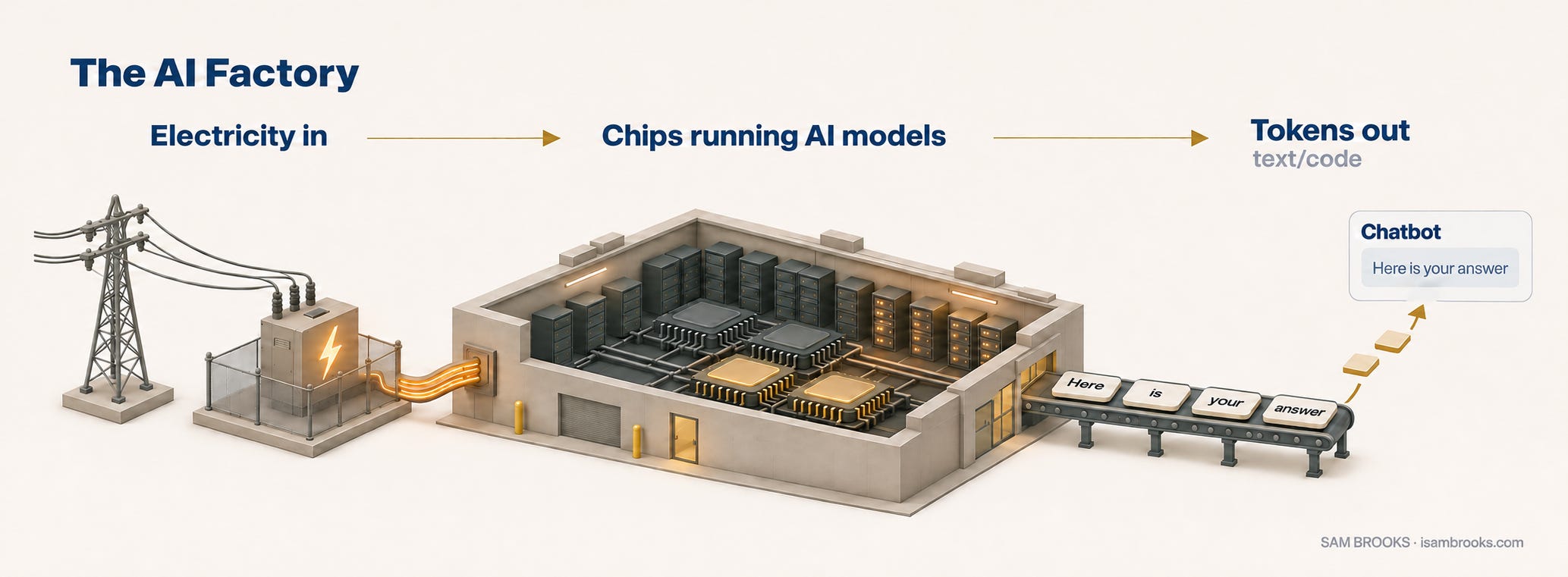
That’s why data centers are described in units of power: megawatts (MW) or gigawatts (GW, which is 1,000 MW). When SpaceX reported 1.7 GW across its factories two weeks ago, that was the total power capacity of its computer chips. Just like a 1,200-watt hair dryer draws 1,200 watts when it’s on, 1.7 GW of chips draw 1.7 GW when they’re on — and a lot less when they’re not.
Nvidia’s newest chips cost $40 billion per GW, so when Elon Musk says he’s “highly confident of 10 gigawatts next year,” that’s $400 billion of machinery. Whether those billions make sense depends on several obvious factors, such as demand for the tokens and how much people will pay for them. But there’s an even more basic question: are you utilizing your factories?
This isn’t an advanced business concept. If you run an airline, you fill the planes you’ve got before ordering new ones. If you own office buildings, you fully lease the ones you’ve got before building more. You don’t expand your restaurant if the current one is half-full.
Yet the AI world almost never talks about utilization. It’s always about capacity, and I think I know why.
I’ve examined some of the factories already built in places like Ellendale, North Dakota, and the suburbs of Memphis. I’ve pieced together tons of power data, from electric meters and turbines and natural gas pipelines, to see how much power is actually flowing, versus how much could flow. And there’s no doubt:
These factories are not fully utilized. Not even close.
Dario’s Pizza
Imagine your local pizza spot, Dario’s Pizza, has one of those big, fancy pizza ovens. One night Dario stops by your table beaming: he’s signed a lease for a second oven. It’s expensive, sure, but people love this pizza. Now get this: across town, Satya’s Pizza just bought four new pizza ovens. Four! And Elon’s Pizza is making its own ovens; the owner says they’ll have ten by next year. Ten!
If you were a pizza investor, you’d have questions. How much does a pizza cost? How much pizza can this pizza-crazed town even eat? But before you put a dollar into Dario’s or Satya’s or Elon’s, you’d better find out: Are they fully utilizing the ovens they already have? Because if they’re making 100 pizzas a night in an oven built to make 200, they don’t need a new oven. Or ten.
Factories: Best When Used
Rule one of factories: use them. As much as you possibly can.
Steelmakers have been doing the factory thing for a while, and they live by this. Nucor, the largest in North America, ran its mills at 89% in the third quarter. For every 100 tons of steel its factories could make, they made 89. Steel Dynamics did even better, at 92%, and its CEO bragged about it. The company’s strategy, he said, “supports stronger through-cycle facility utilization and drives superior financial performance.” Translation: they ran their factories hard, so they made a lot of steel, so they made a lot of money.
The token factory known as Anthropic understands all this. Its IPO filing names “Compute Efficiency” as one of the main drivers of financial performance: “We are focused on increasing the intelligence produced and revenue generated per dollar of compute invested.” In a section titled “Securing Sufficient Compute and Optimizing its Utilization,” which wasn’t at all repetitive or a parody of AI writing, the company explained:
“Optimizing the utilization of our compute… We rely on compute efficiencies, such as the discovery of compute multipliers, to get the most out of the compute that we procure. Our ability to effectively direct compute and drive compute efficiencies...” (Emphasis added.)
At least on paper, Anthropic wants its factories working, not idle, because the harder they run, the more money they make.
“Never Sits Idle”
Polaris Forge, in Ellendale, North Dakota, has everything an AI factory needs: the building, the chips, the power.1
Its landlord, Applied Digital, said last November the first building was running at “full 100 MW critical IT load,” which is industry-speak for 100 MW of chips. In an SEC filing this April, it confirmed the building “was fully operating during the current quarter.”
The chips here belong to CoreWeave, which fills data centers with Nvidia chips (GPUs, in the industry’s shorthand) and rents time on them to firms such as Anthropic.2 One of CoreWeave’s main selling points is keeping the chips busy. Without the right setup, CoreWeave warns, “it’s almost impossible to guarantee that your GPU resources are being utilized to their fullest.” Its fix: “GPU elasticity … allows you to ensure that capacity never sits idle.”
Applied’s other big Ellendale factory is a bitcoin mine, and it’s anything but idle. The local utility, Montana-Dakota Utilities (MDU), reports one number for all of its North Dakota commercial customers, added together, so it’s rare for any single customer to move it. But when the mine switched on in March 2023, that number more than doubled, from a steady 120 MW to 280 MW.
Next door, Polaris Forge has been plugged in for nearly two years. The campus had 225 MW of electric service when its substation was energized in December 2024, and two months later, regulators approved it for up to 350 MW.
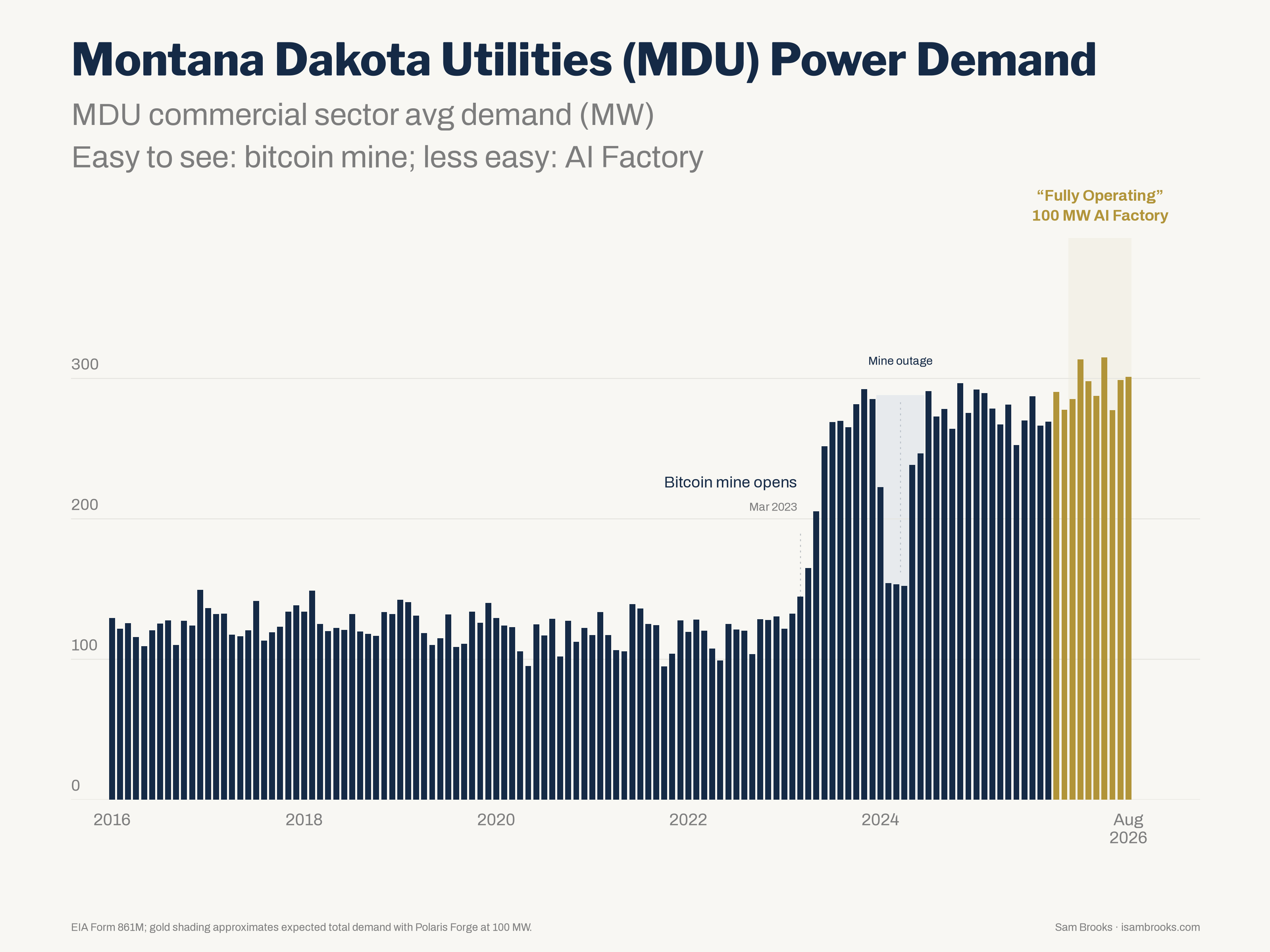
And yet, Polaris Forge has barely moved the meter.
All of MDU’s North Dakota commercial customers pulled 22 MW more this summer than the year before. After accounting for the power Applied says the buildings use for cooling and other non-chip needs — and assuming Polaris Forge was responsible for every watt of the increase — that’s about 19 MW of chips. Applied said the first building was operating at 100 MW.
Nineteen.
Applied is expanding anyway. “175 MW now live at the campus,” it announced in a July press release that said “AI Factory” five times. Last month, with 250 MW of capacity, it declared the campus “fully operational.”
Half-Lit Factories
Everywhere I’ve looked, AI factories are running at a fraction of their capacity.3
Colossus 2
Elon Musk’s data center in the suburbs of Memphis runs on its own fleet of natural-gas turbines, which make the power flows unusually easy to see. Two public records — a log of each turbine’s running hours, and the pipeline’s daily gas deliveries — pin down how much power is getting to the chips.
SpaceX, which owns the AI company xAI, told the SEC it had 1,400 MW of chips installed at the end of June; by my count, that meant 1,080 MW at Colossus 2. As I reported several weeks ago, the turbines that ran in June generated enough power for about 550 MW of chips.4 In other words, the factory was running at about half.
New gas pipeline data extends the picture through September 30. By then, SpaceX told Wall Street, it had 1.7 GW, about 1,380 MW of that at Colossus 2. According to the gas data, the turbines were burning enough fuel to run about 775 MW of chips. The “optimized AI factory” was still running at barely more than half its capacity.
Georgia
Georgia Power has spent years amassing electric capacity for data centers, as I wrote here. Microsoft alone is on the utility’s books for 1,157 MW of power this year, across six data centers with signed contracts for electric service. Some have been plugged in since 2024, including Fairwater, the project that Microsoft calls part of a “planet-scale AI superfactory.”
Through August, Georgia Power’s entire commercial sector (Microsoft, every other data center, and every office, store, and hospital) averaged just 388 MW more than a year earlier. If Georgia Power’s data centers were running anywhere near their available capacity, it would show up on the utility’s meter. It doesn’t.
Power Traders
Yes Energy sells power-market data to hedge funds and commodity traders. It tracked the power flowing on transmission lines that feed data centers, including Oracle’s Project Abilene. Its advice to traders:
“… [L]oads from these facilities are not ramping at the reported levels. If you’re building a model, we recommend using 50% or 60% of the reported capacity as the actual load.”
The people who watch power flows for a living, and who lose money when they get them wrong, say the AI factories utilize about half their power.
In Their Own Reports
“Nvidia Compute is fully utilized,” CFO Colette Kress told investors in August, after saying in February that Nvidia’s newest chips were all “deployed and consumed.” That’s a lot of chips to vouch for. Per Epoch AI, Nvidia makes about two-thirds of the world’s AI chips (measured by power), and total sales come to about 19 GW.
If all these chips were deployed and consumed in AI factories, the buyers’ own power numbers would show it. They don’t. Most big tech companies publish their electricity use once a year, in sustainability reports that weren’t written to say how hard their AI factories are running — but the numbers are in there anyway.
Microsoft is a clear case, because its CEO keeps putting a number on its factory capacity. “We stood up more than 2 gigawatts of new capacity over the past 12 months alone,” Satya Nadella said in July 2025. In Microsoft’s most recent sustainability report, which covers those same 12 months, company-wide electricity use rose about 830 MW. Some of that went to Microsoft’s non-AI business, so the AI chips got less than that. Either way, it’s not even close to the 2,000 MW (2 GW) Nadella claimed.
Meta’s sustainability report for 2024 shows its data center chips drawing about 320 MW more than the year before — less than half the chip power Epoch estimates Meta installed that year. (Meta still hasn’t released its report for 2025.)
Google’s chips in data centers drew about 1,240 MW more in 2025 than in 2024 — less than half the chip power Epoch says Google installed that year.
The National Meter
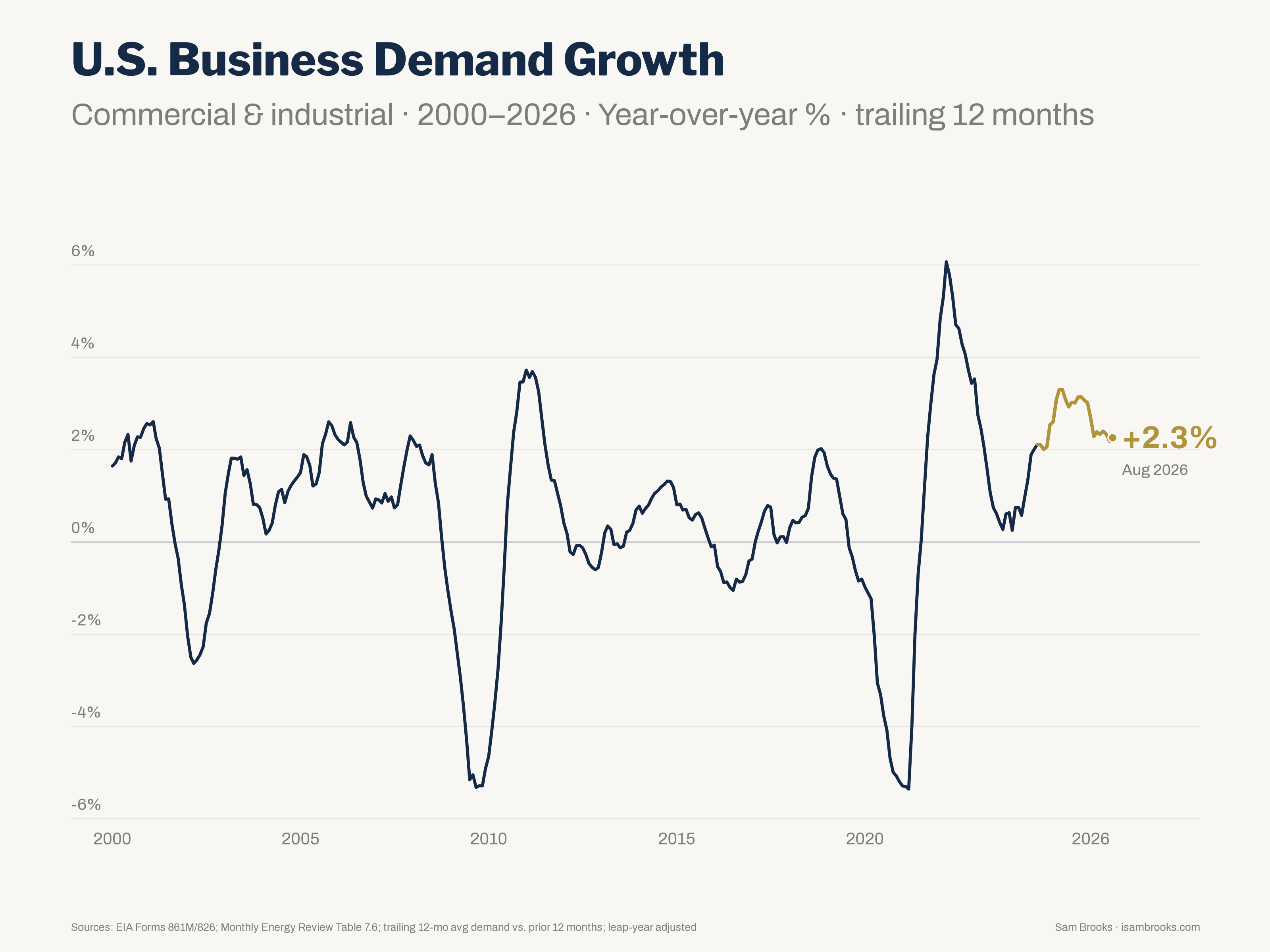
Running flat out, the AI chips added in American data centers in the 12 months through August — plus their servers and cooling, minus the sites off the grid — would pull about 9 GW from the grid.6
Over those same 12 months, every business in America combined (all offices, steel mills, bitcoin mines, and data centers) added only 6.5 GW of power demand.7 With an allowance for everything else that grew — a bigger economy (~2 GW) and manufacturing coming back onshore (~1 GW) — that leaves 3 to 4 GW of new demand from AI data centers. In other words, the new AI chips were pulling less than half of what they could.
One Number Away
Most people in the AI industry learned how business works from software, which is basically the opposite of a factory company. Almost no capital expenditures, not a factory in sight. So perhaps it’s not surprising that AI companies don’t disclose the utilization of their chips.
Musk doesn’t have that excuse: Tesla is a factory company, and it reports like one. Each quarter, it tells investors how many cars its factories actually built, versus how many they could build — lately, about 81% for its Model 3 and Model Y lines — and says it’s “optimizing our existing production capacity before building new factories and production lines.” The first line of its latest quarterly outlook: “We are focused on maximum capacity utilization at our factories.”

Musk’s SpaceX has tiptoed up to the line. In its SEC filings, it publishes the chip number cited earlier (1.7 GW in Q3; 1.4 GW in Q2) and calls it “nameplate compute”: “the number of GPUs installed in our data centers at the end of the period multiplied by their respective all-in power.” Then it adds that the figure “does not represent actual power consumption or utilization.”
It’s so close. One more number — what the chips are drawing — and it’s simple division to get the AI factory’s utilization, a figure to put next to Nucor’s 89% and Tesla’s 81%. The number would take less space than the disclaimer.
On SpaceX’s recent earnings call, the same one where Musk was “highly confident” of 10 GW next year, he said:
“You don’t hear a lot of detail from other hyperscalers about how many GPUs they’re actually turning on every month. And with us, you are.” (Emphasis added.)
Except, we’re not. Musk is talking about how much could be turned on, not how much actually is. It’s like Tesla announcing it can build 2.25 million cars per year, and then never saying how many it built. The first number is useful, but without the output you only see half the picture.
Real factory companies report everything. But nobody in the AI industry — not Musk, nor Anthropic, not the planet-scale superfactory people — will talk about their factories’ utilization. They’ll tell you all about the next ten factories, but nothing about the ones already built.
SOON
The electric utilities are building power plants as if every one of these factories will run flat out. Got a GW-sized plan for a data center? You get a GW-sized power plant.
This could have catastrophic consequences. For these utilities, or our power bills, or both.
Polaris Forge is a good example because of its underutilization, but also because of something else that will hurt the feelings of AI boosters: it’s had plenty of power for years — power it’s not even using.
If you listen to ten minutes of any tech podcast or financial-news segment on AI data centers (sorry, factories), you’ll hear it: power is the bottleneck. From the last two weeks alone: Goldman’s Jason Tofsky, “Power is probably the forever bottleneck” (Axios, 10/20/26); investor Brad Gerstner, “it’s only so fast that we can bring power on” (CNBC, 10/21/26); Blackstone’s Jon Gray, “getting entitlements, getting power” (Blackstone Q3 call, 10/22/26).
It. Never. Ends. And it’s not true. There is no shortage of power for AI factories.
Just look at Georgia Power, which got approval in 2025 to keep 4,200 MW of old plants running and to add another 9,885 MW of generation. Its CEO says it’s not enough. By Georgia Power’s own count, all of its data center customers — every single one of them combined — had added 612 MW by the end of last year. I’m nearly certain OpenAI could plug in its Project Camellia (3,200 MW) next year, no problem.
The real risk is the opposite: too much power amassed for factories that aren’t using it. This page will get into all of that soon; you should subscribe!
Who does what at Polaris Forge:
Anthropic, among others, rents time on the factory’s chips.
But Anthropic doesn’t own the chips. CoreWeave does.
But CoreWeave doesn’t own the buildings that house the chips. Applied Digital does.
But Applied Digital doesn’t own the power line that feeds the buildings. Montana-Dakota Utilities (MDU) does.
Nvidia, the company that makes the chips, has invested money in Applied Digital. And in CoreWeave. And in Anthropic.
So Anthropic’s money, some of which it got from Nvidia, goes to CoreWeave; CoreWeave’s money goes to Nvidia, for chips that sit in Applied’s building, which Nvidia helped pay for and CoreWeave rents. And the power running through Nvidia’s chips, that are owned by CoreWeave, comes from wires owned by MDU, which has an electricity contract with Applied Digital.
It’s a shocker this factory isn’t humming.
A note on “chips.” The industry’s numbers — SpaceX’s 1.7 GW, Applied’s 100 MW, Nadella’s 2 GW, Epoch’s figures — are the power the chips draw. Many sources measure the whole building: a utility meter, a gas pipeline, a sustainability report. A building uses more power than its chips, because of cooling and everything else; it’s typically 10 to 20% more, a ratio called Power Usage Effectiveness (PUE).
For the site and company comparisons, I’ve converted building-level numbers to chips. When a company publishes its own PUE, I’ve used that company-specific factor (Microsoft 1.17, Google 1.09, Meta 1.08, Applied Digital 1.2); otherwise, I’ve used 1.2.
“Installed that year,” for Meta and Google, means the increase in installed AI chips from the end of one year to the end of the next, calculated from Epoch’s data (about 770 MW for Meta in 2024 and about 2,900 MW for Google in 2025, counting the chips and their servers). This is similar to Nadella’s “2 gigawatts over the past 12 months,” which meant capacity added over a year.
A visualization of my methodology and Colossus 2’s power flows:
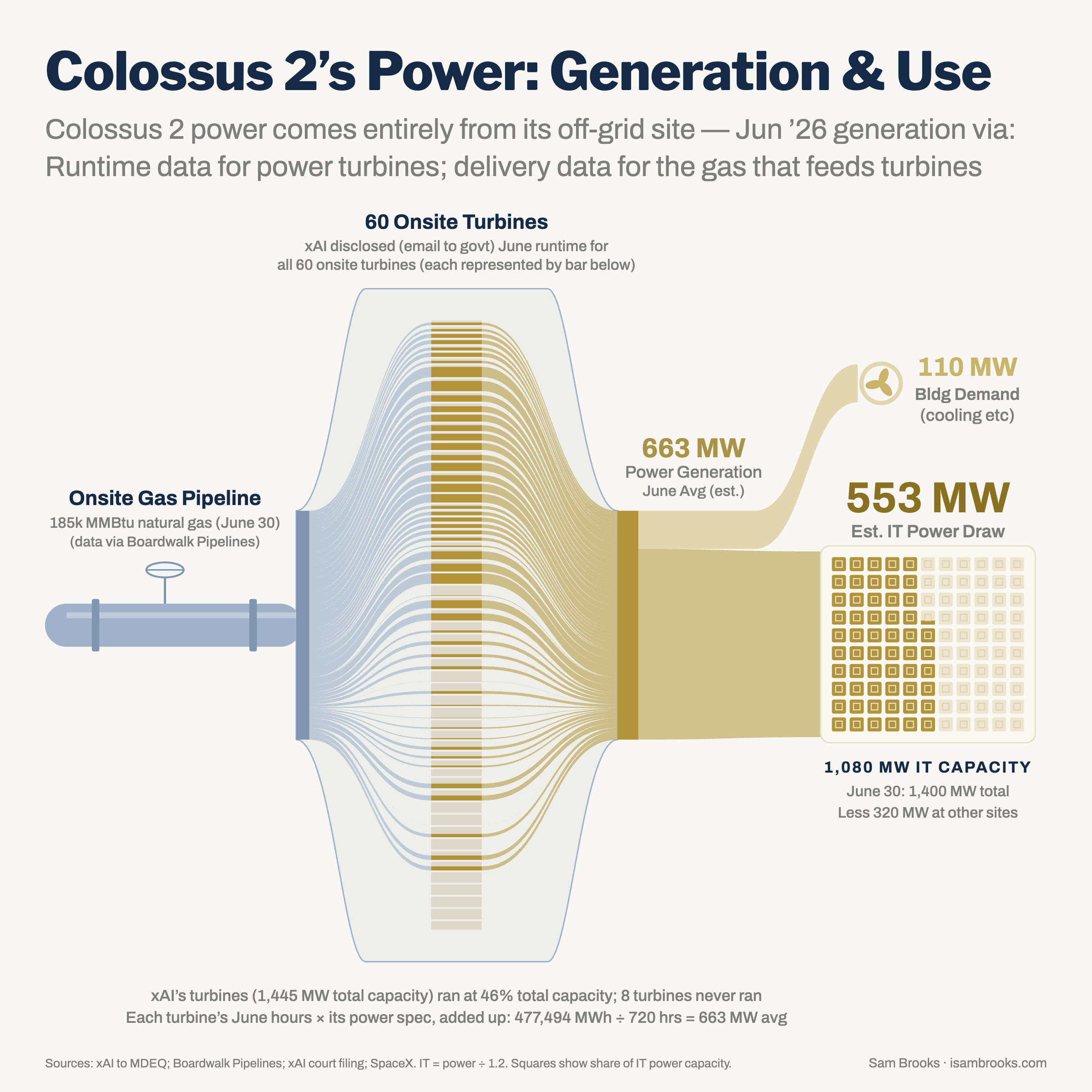
June’s estimate multiplies each turbine’s listed output by its reported running hours. September 30’s estimate converts 247,830 MMBtu of pipeline gas at 11,100 Btu per kilowatt-hour, which is the heat rate implied by comparing the June runtime data and gas data. Both figures remove cooling and other overhead using a 1.2 ratio.
Colossus 2’s capacity is SpaceX’s total — 1,400 MW at the end of June, 1,700 MW at the end of September — less about 320 MW at Colossus 1, calculated from the chip counts Musk posted on X at the power per chip SpaceX reports.
Microsoft. Nadella’s claim covers Microsoft’s fiscal 2025: July 2024 through June 2025. Microsoft’s own environmental data sheet puts company-wide electricity at 29.8 million MWh in fiscal 2024 and 37.0 million in fiscal 2025 — an increase of about 830 MW of average power. That accounts for everything Microsoft runs, owned and leased, not just AI chips. (The same sheet lists Microsoft’s owned data centers one by one; they add up to about 16 million of the 37 million MWh, so the leased sites are in the total.) Microsoft’s reported PUE of 1.17 means the chips’ share is about 710 MW. Microsoft was adding 300–500 MW a year before ChatGPT existed, as Azure and the rest of the business grew, so the AI chips’ share is less than 710 MW. I don’t have the exact number, but it’s nowhere near 2,000 MW.
Meta. Meta’s environmental data index puts its data centers’ electricity at 14.98 million MWh in 2023 and 18.06 million in 2024, including owned and leased sites — an increase of about 350 MW of average power. Applying Meta’s reported PUE of 1.08 means the chips’ share is about 320 MW. That figure includes all its computing, not just AI. Even before ChatGPT, Meta’s computing demand was growing by about 230 MW a year, on average, from 2020 to 2022. So the added demand from AI chips for 2024 was roughly 100 MW.
Google. Google’s environmental report puts its data-center electricity use at 30.6 million MWh in 2024 and 42.4 million in 2025, including owned and leased sites — an increase of about 1,350 MW of average power. Applying Google’s reported PUE of 1.09 means the chips’ share is about 1,240 MW. That figure includes all its computing, not just AI. Even before ChatGPT, Google’s computing demand was growing by about 320 MW a year, on average, from 2020 to 2022. So the added demand from AI chips for 2025 was roughly 900 MW.
“9 GW”: This number runs the other way from the rest of the piece — up to the building, not down to the chips — because it’s compared with what the grid delivered. Epoch estimates the AI chips in use worldwide, averaged over the 12 months through August, were about 7.3 GW higher than the 12 months before, counting the chips alone and allowing three months between purchase and plug-in. Epoch also estimates that about 72% of the world’s AI computing is in the U.S. (5.3 GW). After accounting for the servers (1.7x) and the cooling (1.2x) a data center uses, the total load would be roughly 10.7 GW. I estimate about 1.5 GW of that is at off-grid sites (mostly Colossus 2), so I subtract that from possible grid impact.
7.3 × 72% = 5.3 GW; * 1.7 [servers] * 1.2 [buildings] = 10.7 GW; − 1.5 [off the grid] = 9.2 GW
That’s what the grid would have delivered if every new chip ran flat out.
“6.5 GW”: Energy Information Administration (EIA) data, Form EIA-861M, comparing the 12 months through August 2026 against the 12 months before (converted to average power).
RE 6.5 GW → 3 - 4 GW:
Business demand moves every year — as the economy grows, demand among stores and offices grows, too — so I’ve tried to account for this before crediting any growth to AI chips. Southern Company, one of the country’s biggest utilities, says its commercial sales grew about 1% last year excluding data centers. To simplify things, I’ve used Southern Company’s figures as a proxy for the national trend: 1% of U.S. business sales outside of manufacturing and data centers (~180 GW total) is roughly 1.8 GW.
Manufacturing is also pulling more power. The Census Bureau’s survey of manufacturers reports total demand of about 80 GW. The Federal Reserve reports manufacturing output grew about 1% over the past year, so manufacturing accounts for roughly .8 GW of the country’s added demand. (The same Fed report publishes factory utilization every month (76% in September), because that’s what real factory data looks like.)
6.5 - 1.8 [non-AI business demand growth] - .8 [non-AI manufacturing demand growth] = 3.9 GW
I haven’t accounted for bitcoin mining or EV charging, both of which probably grew; so, if anything, the AI share may be closer to 3 GW.
Note that these numbers are not weather-normalized. I’ve examined weather in detail (I’ve got a weather normalization model and everything), and if anything it makes AI chip demand look bigger than it is. This August was unusually hot, which nudged demand up, so part of the 6.5 GW of added demand is likely from weather. But the effect is small; and weather moves businesses far less than homes; and it barely moves industrial facilities, including data centers; and weather modeling gets tricky across different climates; and weather effects wash out over a long enough time series. So I left it out.
Why would they deceive us? they CAN run at capacity. Can? can.
Half-used halls next to multi-year waitlists is the utilization–power mismatch in one picture. Live DCPI (Data Center Power Index) still splits where new load can land: Midland–Odessa is 80.6 BUILD, Dallas 42 CAUTION, and Ashburn 20 AVOID (DC Hub (dchub.cloud), as of 2026-11-06). Spare rack hours do not rewrite a constrained interconnection outlook in the tight metros.